




What You're Seeing Up There
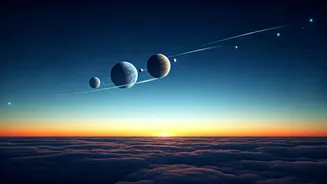
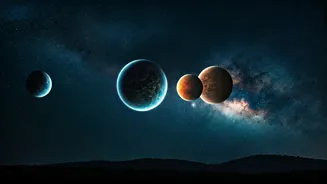
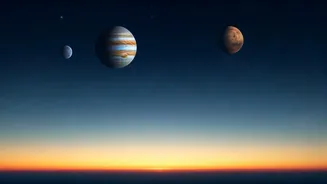
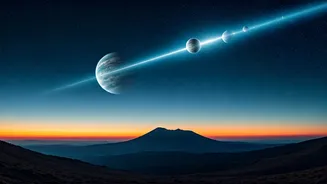
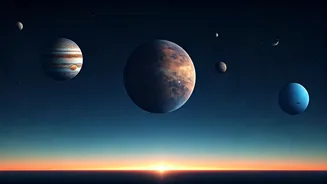
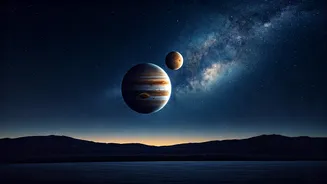
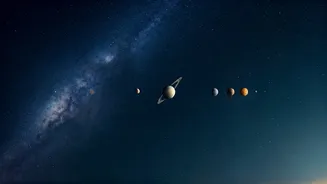
A planetary alignment occurs when several planets appear close to one another in the sky from our vantage point on Earth. While they aren't physically in a straight line out in space, their orbits bring them into the same small section of our night sky.
What makes this event special is the number of participants. You’ll be able to spot up to six planets: Mercury, Mars, Jupiter, Saturn, Uranus, and Neptune. While the brighter planets like Jupiter and Saturn are easy to see, spotting the entire procession is a rare treat that requires a bit of patience and preparation. It's a beautiful reminder of the grand, clockwork-like nature of our solar system, visible from your own backyard.
When and Where to Look in India
Timing is everything in astronomy. For this alignment, your best viewing window is in the pre-dawn hours. Start looking about an hour before sunrise. Find a spot with a clear, unobstructed view of the eastern horizon, away from the glare of city lights if possible. The planets will be strung out in a diagonal line. Jupiter will likely be the brightest and easiest to spot, serving as your anchor. From there, you can trace the line to find Saturn and Mars. Mercury will be the trickiest, as it’s very close to the horizon and only visible briefly before the sun’s light washes it out. A planetarium app on your phone can be an invaluable guide to pinpoint each one.
Your Viewing Toolkit: From Eyes to Optics
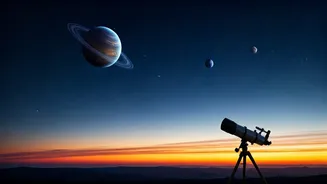
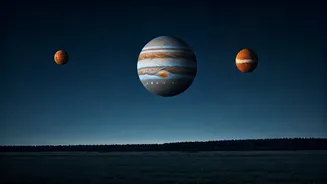
You don’t need to be a professional astronomer to enjoy this. Here’s what works at different levels: **Naked Eye:** You can easily see the brightest planets—Jupiter, Saturn, and Mars—as distinct, star-like points of light that don't twinkle as much as stars do. Venus, if part of the alignment, is unmissable as the brightest object after the Moon. **Binoculars:** A standard pair of 7x50 or 10x50 binoculars will dramatically enhance your view. You'll be able to see the planets as small discs rather than points of light. You might even glimpse Jupiter’s four largest moons (the Galilean moons) as tiny pinpricks of light huddled close to the planet. **Telescope:** This is where the magic happens. Even a small beginner's telescope will reveal Saturn’s iconic rings and the cloud bands on Jupiter. For fainter planets like Uranus and Neptune, a telescope is essential. They will appear as tiny, pale blue or greenish dots.
Capturing the Cosmos: A Photo Guide
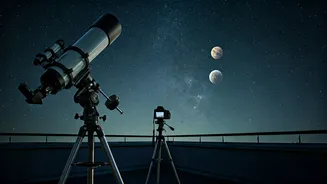
The “tracking gear” isn't just for seeing; it’s for photographing. While a dedicated tracking mount that follows the stars is ideal, you can get great shots with a standard DSLR or even a capable smartphone. **The Tripod is Non-Negotiable:** To capture the faint light of planets without blur, your camera must be perfectly still. A sturdy tripod is the single most important piece of gear. **Camera Settings (DSLR/Mirrorless):** Switch to Manual mode (M). Start with these settings and adjust as needed: - **Lens:** A wide-angle lens (18-35mm) is great for capturing the entire alignment. - **Aperture:** Set it as wide as possible (e.g., f/1.8 to f/4). This lets in more light. - **Shutter Speed:** Start with 5-10 seconds. Any longer and the Earth’s rotation will cause stars to streak. - **ISO:** Begin at 800 or 1600. Increase if the image is too dark, but be mindful that higher ISOs add noise or grain. - **Focus:** Use your camera's live view, zoom in on a bright planet like Jupiter, and manually adjust the focus ring until it's a sharp point of light. **Smartphone Tip:** Use your phone’s ‘Pro’ or ‘Night’ mode to manually control shutter speed and ISO. A small, inexpensive phone tripod is a game-changer.
Helpful Apps for Your Celestial Hunt
Don't wander in the dark. Use technology to guide you. Download a stargazing app before you head out. Apps like Stellarium, SkyView, or Star Walk use your phone's GPS and compass to create a real-time map of the sky. Simply point your phone at the horizon, and the app will identify the planets, stars, and constellations for you. It takes the guesswork out of finding faint objects like Uranus and helps you distinguish planets from bright stars. Many also have features that show you exactly where the alignment will be at a specific time, making your planning much easier.