



1. Mumbai: The Epicentre of Grandeur
When you think of Ganesh Chaturthi, you probably think of Mumbai. The city transforms into a massive festival ground, where celebrations are defined by their sheer scale. Giant pandals (temporary shrines) housing colossal idols, some over 20 feet tall,
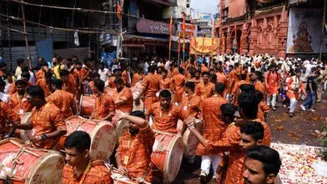
become landmarks. The most famous, Lalbaugcha Raja, draws millions of devotees who queue for hours, sometimes days, for a glimpse of the idol. This tradition of public celebration was popularised by freedom fighter Lokmanya Tilak to unite people. The festival culminates in the 'visarjan' (immersion), when thousands of idols are carried to the sea in spectacular, energetic processions that fill the streets with chants and dhol-tasha drums.
2. Pune: The Cradle of Tradition
If Mumbai is about grandeur, Pune is the heart of tradition. This is where Lokmanya Tilak first transformed the festival into a public event in 1893 to foster unity during the freedom struggle. The city's celebrations are deeply rooted in history, led by the five 'Manache Ganpati' or 'honoured Ganpatis'. These five specific mandals, including Kasba Ganpati and Tambdi Jogeshwari, hold a fixed, revered order in the immersion procession, a tradition that continues to this day. Pune's celebrations are noted for being more intimate and culturally focused than Mumbai's, with an emphasis on historical legacy and community programmes.
3. Hyderabad: Home of the Colossal Idol
Hyderabad's celebration is dominated by one name: the Khairatabad Ganesh. For decades, this pandal has been famous for creating one of India's tallest Ganesh idols, a tradition that draws devotees from across the country. In 2026, the idol is a towering 69-foot eco-friendly 'Panchamukha Sankatahara Maha Ganapati'. The making of this gigantic clay idol is an event in itself, involving around 150 artisans over several months. The festival here, known as Vinayaka Chavithi, culminates in a massive immersion procession to Hussain Sagar Lake, turning the city into a sea of devotion.
4. Goa: An Intimate, Eco-Conscious Chavoth
In Goa, Ganesh Chaturthi, or 'Chavoth' as it's locally known, is less of a public spectacle and more of a cherished family affair. It's a time for homecoming, where families gather to decorate a unique wooden canopy called a 'matoli' above the idol. This matoli is adorned with local, seasonal wild fruits and forest produce, reflecting the festival's deep connection to nature and the harvest. While public celebrations happen, the essence of Goan Chavoth lies in these beautifully decorated homes and eco-friendly practices, blending Konkani traditions with the state's laid-back charm.
5. Bengaluru: A Fusion of Culture and Devotion
Bengaluru celebrates Ganesh Chaturthi by treating it as a grand cultural festival. The city's tech-savvy, modern identity blends seamlessly with deep-rooted traditions. The most prominent event is the Bengaluru Ganesh Utsava, held for over 60 years at the National College Grounds. This 11-day extravaganza features a huge eco-friendly Ganesha alongside a series of free classical, film, and fusion music concerts, attracting close to a million people. Beyond the big stage, neighbourhoods come alive with vibrant pandals, and the historic Dodda Ganesha Temple, with its 18-foot monolithic idol, becomes a major hub for devotees.
6. Chennai: The Quiet Devotion of Vinayaka Chaturthi
In Chennai, the festival, called Vinayaka Chaturthi, begins quietly at home. The focus is on simplicity and personal devotion, with families installing small, eco-friendly clay idols. The quintessential offering that defines the festival here is 'kozhukattai', a steamed rice dumpling filled with jaggery and coconut, the Tamil counterpart to the modak. While less extravagant than in Maharashtra, the celebration is deeply traditional. Towards the end of the festival, the streets fill with drum beats as processions make their way to the coast for immersion, a colourful finale to a period of heartfelt, home-based worship.
7. Delhi: A Growing Community Celebration
While not traditionally a hub for Ganesh Chaturthi, the celebration in Delhi has grown significantly, reflecting the capital's diverse, multicultural fabric. The festivities are driven by various community mandals, often organised by migrant communities from Maharashtra and other states. Pandals spring up in different neighbourhoods, becoming centres for cultural activities and community bonding. The celebration here is less about city-wide grandeur and more about creating a piece of home, with societies and communities coming together to install idols, perform aarti, and share festive meals, showcasing the spirit of unity in a metropolitan setting.