


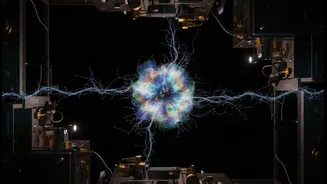


An Even Colder Atom Lab
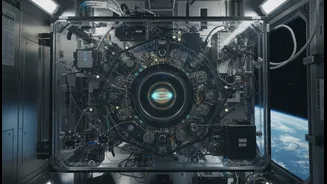
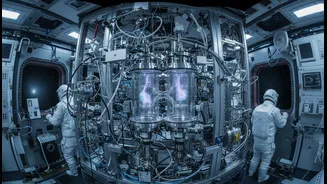
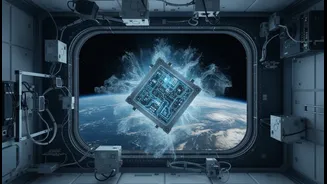
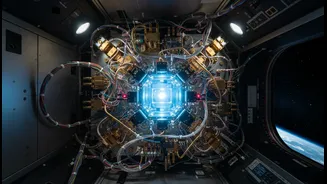
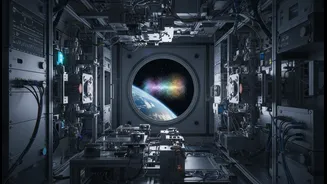
The latest enhancement to the International Space Station isn't a new solar array or robotic arm, but a sophisticated upgrade to a facility the size of a mini-fridge called the Cold Atom Laboratory (CAL). Astronauts installed the new hardware, which represents
the fourth major upgrade since CAL arrived on the station in 2018. The goal of this facility is to study the strange and wonderful world of quantum physics by cooling atoms down to temperatures just a fraction of a degree above absolute zero—the coldest temperature theoretically possible. This recent upgrade, which was launched to the station in April 2026, includes a redesigned magnetic trap and improved atom sources, allowing scientists to create and study exotic forms of matter with greater precision than ever before.
Creating a Fifth State of Matter
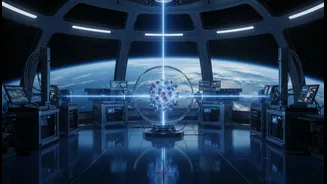
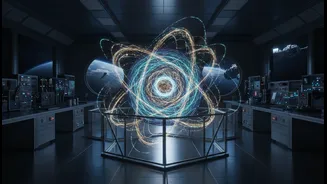
To study the quantum world, scientists first need to slow atoms down from their usual frenetic pace. The CAL uses a combination of lasers and magnetic fields to cool clouds of rubidium and potassium atoms, draining them of their energy. At these extreme temperatures, the atoms stop behaving like individual particles and begin acting like a single, collective wave. This creates a state of matter known as a Bose-Einstein condensate (BEC), sometimes called the fifth state of matter after solids, liquids, gases, and plasmas. In this state, quantum phenomena that are usually confined to the microscopic level become visible on a much larger scale, allowing scientists to observe their bizarre behaviors directly.
The Zero-Gravity Advantage
While scientists have created Bose-Einstein condensates in labs on Earth, the microgravity environment of the ISS offers a crucial advantage. On the ground, gravity quickly pulls the delicate atom clouds apart, limiting experiments to fractions of a second. In space, these condensates can expand and evolve for much longer periods, giving researchers precious time to observe their properties. The persistent microgravity allows the atoms to reach even colder temperatures and form larger quantum waves than is possible on Earth. This unique environment turns the ISS into an unparalleled laboratory for probing the fundamental laws that govern the universe at its smallest scales.
Unlocking Future Technologies
These experiments are not just about exploring esoteric physics. The insights gained from the Cold Atom Lab could pave the way for a new generation of quantum technologies. For instance, the principles learned could lead to the development of ultra-precise sensors capable of mapping Earth's gravitational fields with incredible detail, monitoring environmental changes, or enabling navigation on the Moon or Mars without relying on GPS. The research also supports the development of more advanced quantum computers and more accurate atomic clocks, which are the backbone of global communication and navigation systems. By pushing the boundaries of what's possible in a lab, NASA is maturing the quantum tools of the future.