
The Mystery of the Red Dots
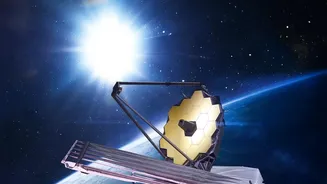
Since it began science operations, the James Webb Space Telescope (JWST) has been capturing breathtaking images of the early universe. Among the glittering spiral galaxies and colourful nebulae, astronomers noticed a recurring new mystery: tiny, distant,
and distinctly red specks of light. Dubbed 'little red dots', these objects are some of the farthest things we have ever seen. Their ruddy appearance is a direct result of their immense distance. As the universe expands, it stretches the light traveling from these ancient sources, shifting it towards the red end of the spectrum in a phenomenon known as redshift. In many cases, these objects are also shrouded in thick cosmic dust, further reddening the light that finally reaches Webb’s powerful mirrors. For a while, their exact nature was a puzzle, but scientists knew that anything visible from across such a vast expanse of space and time had to be incredibly energetic.
More Than Meets the Eye
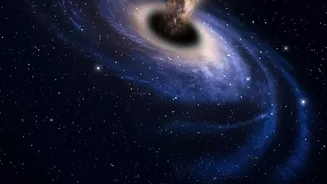
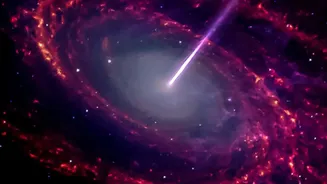
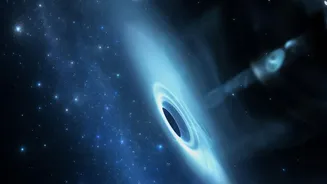
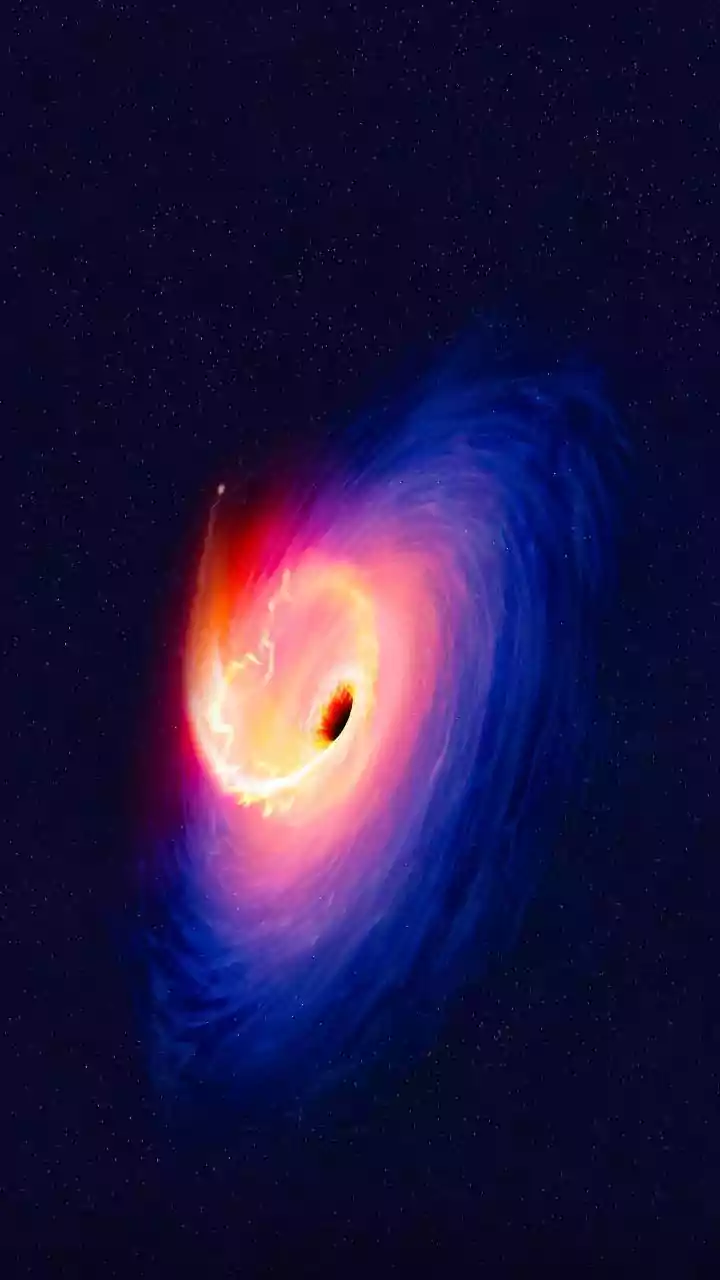
Upon closer inspection, astronomers found that many of these little red dots were not just simple, young galaxies. Instead, they are what scientists call Active Galactic Nuclei, or AGN. An AGN is a galactic core that is fantastically bright, sometimes outshining all the stars in its host galaxy combined. This intense luminosity isn’t caused by stars, but by a supermassive black hole at the galaxy’s center that is actively 'feeding'. As gas, dust, and even stars are pulled into its immense gravitational grip, the material forms a swirling, superheated accretion disk around the black hole. The friction and energy released in this process create a beacon of light so powerful it can be seen across the cosmos. The discovery that these little dots were actually some of the earliest and most distant active black holes ever detected was a major breakthrough.
A Cosmic Mismatch
The real shock came when scientists began to weigh these ancient black holes against their host galaxies. For decades, the prevailing theory has been one of co-evolution: a galaxy and its central black hole grow up together, maintaining a neat and predictable size ratio. In our modern cosmic neighbourhood, a supermassive black hole’s mass is typically a tiny fraction—about 0.1%—of its galaxy's total mass. But JWST’s observations of the early universe have thrown a wrench in that tidy picture. Many of these ancient black holes are 'overmassive', weighing in at 10% or more of their galaxy's mass. In some extreme cases, the black hole seems to be more massive than all the stars in its galaxy combined. It's like finding a small town built around a skyscraper, a cosmic mismatch that defies the established rules of cosmic architecture. One such object, found in the galaxy GN-z11, existed just 400 million years after the Big Bang but was already millions of times the mass of our sun, far too big for its small galactic home.
Rewriting the Rules of Growth
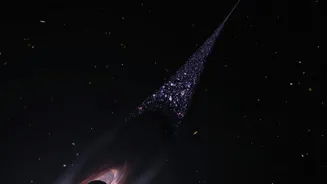
This fundamental discovery is forcing a major rethink of how the first supermassive black holes came to be. The old model of slow and steady growth alongside a galaxy simply doesn't allow enough time for them to get so big, so fast. The 'little red dot' findings suggest an alternative, more dramatic path. Perhaps, in the chaotic conditions of the early universe, black holes got a significant head start. Some theories propose they were born from the direct collapse of massive primordial gas clouds, starting their lives already enormous, rather than from the collapse of a single star. This would mean that in many cases, the galaxy didn't form its black hole; the black hole may have formed first and acted as a gravitational seed around which the galaxy began to grow. This makes the little red dots a snapshot of a frantic, short-lived growth phase that was common in the early universe but has since faded.