




A Crisis in Low Earth Orbit
Launched in 2004, the Swift Observatory is NASA’s rapid-response spacecraft, designed to hunt for gamma-ray bursts (GRBs)—colossal explosions happening across the cosmos. True to its name, it can pivot in seconds to catch the fleeting afterglow of these
events, providing invaluable data for astronomers worldwide. But after 20 years of service, its mission is threatened not by a technical failure, but by gravity. Increased solar activity has caused Earth's upper atmosphere to expand, creating more drag on the satellite. Lacking its own propulsion system for orbital boosts, Swift has been losing altitude, dropping from its original 370 miles to around 230 miles, on a slow but steady path toward a fiery reentry.
The Old 'Use and Lose' Model
For most of spaceflight history, satellites were built with a finite lifespan. Like a car with a sealed bonnet, spacecraft like Swift were never designed to be refueled, repaired, or serviced. Once they ran out of fuel or a critical component failed, their missions would end. The Hubble Space Telescope, serviced multiple times by astronauts during the Space Shuttle era, is a famous exception. For an un-crewed observatory like Swift, a physical repair mission was long considered impossible. The default outcome was for it to eventually burn up in the atmosphere, a costly piece of technology lost forever.
An Unprecedented Rescue Plan
Instead of letting its valuable observatory perish, NASA opted for a groundbreaking solution. In September 2025, the agency awarded a $30 million contract to a private company, Arizona-based Katalyst Space Technologies, to attempt the impossible: a robotic rescue. The challenge was immense. Katalyst was given less than a year to design, build, test, and launch a robotic servicing vehicle—a mission timeline that is incredibly fast by NASA standards. The result is a spacecraft named LINK, a robotic tugboat designed to give Swift a new lease on life. This represents a major shift in thinking, moving away from a disposable culture toward one of sustainability and reuse in orbit.
Meet the Robotic Lifesaver
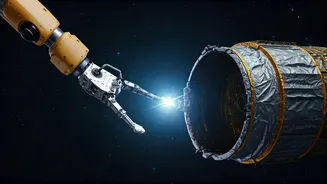
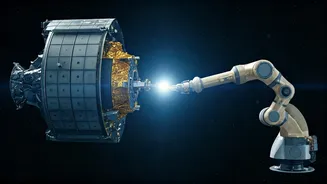
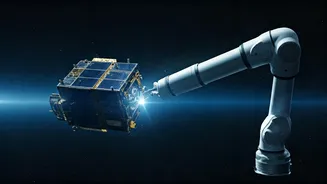
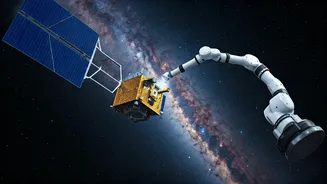
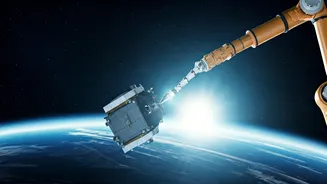
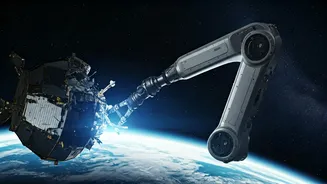
The LINK spacecraft is a marvel of ingenuity, built for a delicate and dangerous task. Its mission is to rendezvous with Swift in orbit, a complex chase that will take weeks. Since Swift has no docking port, LINK must carefully approach and grab the telescope using its three robotic arms—a maneuver that has never been attempted on a U.S. government satellite that wasn't designed for it. Once it has a secure hold, LINK will use its own gentle thrusters to slowly push the observatory into a higher, more stable orbit about 100-150 miles up. If successful, this boost could extend Swift’s operational lifespan by another decade.
A High-Stakes Launch
The launch of this historic mission is as unique as the task itself. The LINK spacecraft is packed inside a Pegasus XL rocket, which is carried aloft by a modified L-1011 jet called Stargazer. The plan is for the jet to release the rocket mid-air high over the Pacific Ocean. However, the mission, originally planned for late June and early July 2026, has faced delays due to weather and a software glitch with the launch vehicle. The teams are working to set a new launch date. The entire space industry is watching closely. This mission isn't just about saving one telescope; it's a proof-of-concept for a new era of in-space servicing.