




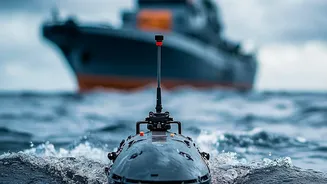
The idea of self-driving ships navigating the world's oceans is moving from science fiction to reality, thanks to a major breakthrough from IIT Madras. Researchers have developed SeaNav, a cutting-edge virtual testbed for autonomous maritime technology.
What is SeaNav?
SeaNav is a real-time 'digital twin' platform developed by the Department of Ocean Engineering at IIT Madras. Think of it as a hyper-realistic video game for self-driving ships. It creates a high-fidelity virtual maritime environment where the navigation and control algorithms for autonomous vessels can be tested, validated, and trained without the enormous cost and risk of real-world trials. The global shipping industry is responsible for carrying over 80% of world trade, and accidents are often attributed to human error. Autonomous vessels promise safer, more efficient transportation, but testing them on the open sea is complex and dangerous. SeaNav provides the perfect solution: a virtual sandbox to work out the kinks before a single robotic ship leaves port.
Creating a Virtual Ocean
Built on the powerful Unity3D engine, SeaNav simulates the complex realities of the sea. It replicates ocean waves, vessel movements, sensor data, and boat traffic with remarkable accuracy. To ensure the simulation is true to life, the system has been calibrated using a benchmark model of a 320-meter-long commercial tanker. This means the results from the virtual tests closely mirror how a real ship would behave. The platform combines digital twin technology with artificial intelligence (AI), advanced sensor fusion, and even virtual reality (VR) to create an environment where both autonomous systems and human operators can be trained safely and efficiently.
Why This Innovation Matters
The development of SeaNav is a crucial step for India's maritime ambitions. It aligns perfectly with national initiatives like the 'Sagarmala Programme' and 'Maritime India Vision 2030', which focus on developing smart ports and embracing digital technologies. By creating an indigenous testbed, India reduces its dependency on foreign technology and builds a foundation for becoming a leader in maritime automation. According to Dr. Suresh Rajendran, an Associate Professor in IIT Madras's Department of Ocean Engineering, this technology can significantly strengthen safety at major Indian ports like Chennai, Mumbai, and Kochi by helping develop AI-assisted navigation systems that reduce collisions and grounding risks.
Beyond Commercial Shipping
The applications for SeaNav and the technologies it helps develop extend far beyond just cargo ships. Its ability to simulate multiple vessels at once makes it valuable for coastal surveillance, search-and rescue operations, and maritime defence applications. Smarter navigation algorithms tested on the platform can also lead to more efficient routes, which reduces fuel consumption and lowers carbon emissions. This not only cuts costs for shipping companies but also minimises the environmental risk of accidents like oil spills. This work builds on a strong foundation at IIT Madras, whose National Technology Centre for Ports, Waterways and Coasts (NTCPWC) is the technological arm of the Ministry of Shipping and a hub for maritime innovation.
From Virtual Seas to Real_World Deployment
While SeaNav is a significant leap forward, the journey to fully autonomous shipping is a gradual one. An IIT Madras_incubated startup, AstraYAN, is already working on the next phase, developing the integrated systems needed to connect autonomy software with a ship's physical machinery like propulsion and power. This shows a clear roadmap from virtual testing to real_world application. The expertise at IIT Madras has already been proven on the world stage, with a student team winning a global autonomous boat challenge in Norway in 2026. With SeaNav providing the critical testing infrastructure, India is now better positioned than ever to navigate the future of smart and autonomous maritime transport.