



Our Invisible Reliance on Orbiting Tech
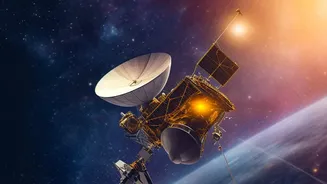
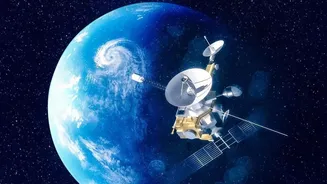
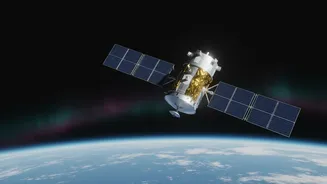
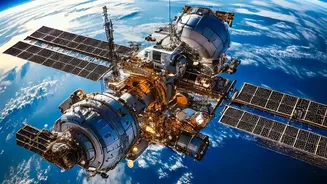
In modern India, satellites are the unsung heroes of our daily lives. They are the backbone of the navigation systems that guide our cabs and deliveries, the broadcast networks that bring us news and entertainment, and the communication links that connect
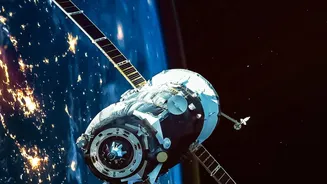
the most remote parts of the country. This reliance is only growing, with satellite-based internet becoming more common. Yet, this multi-billion dollar infrastructure, floating silently in space, is highly vulnerable to violent outbursts from our own Sun, a phenomenon broadly known as space weather.
What Is Space Weather?
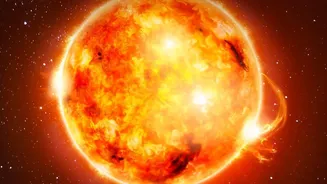
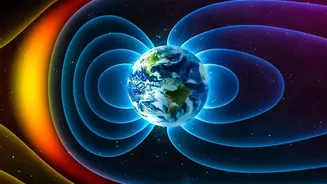
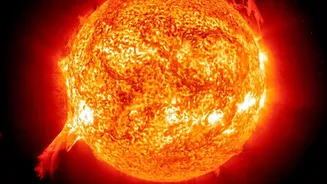
Space weather refers to the changing conditions in space caused by the Sun's activity. The Sun is not a calm, steady star. It constantly releases a stream of charged particles called the solar wind. More dramatically, it can produce solar flares, which are intense bursts of radiation, and Coronal Mass Ejections (CMEs), which are massive eruptions of plasma and magnetic fields hurled into space. When Earth is in the path of these events, they can trigger geomagnetic storms in our planet's magnetic field and upper atmosphere, creating significant risks for our technology.
How Solar Storms Disrupt Satellites
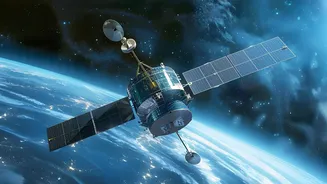
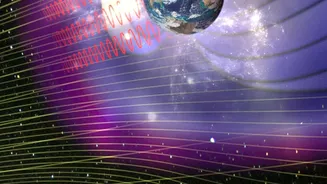
The impact of a solar storm on a satellite can be devastating. There are four main threats. Firstly, energetic particles can penetrate a satellite’s electronics, causing phantom commands, short circuits, or permanent damage to sensitive components. Secondly, this radiation degrades solar panels over time, reducing a satellite's power supply and shortening its operational lifespan. Thirdly, storms heat Earth's upper atmosphere, causing it to expand. This increases the atmospheric drag on satellites in Low-Earth Orbit (LEO), slowing them down and causing their orbits to decay. In a dramatic 2022 incident, a relatively minor geomagnetic storm caused up to 40 newly launched Starlink satellites to fail because they couldn't overcome this increased drag. Finally, disturbances in the ionosphere can disrupt the radio signals used for communication and GPS, leading to inaccurate data or complete signal loss.
The New Science of Forecasting the Sun
For decades, predicting the exact impact of a solar storm has been a major challenge. But science is fighting back. Researchers are developing new models, some powered by artificial intelligence, to better forecast when a CME will hit Earth and how intense the resulting geomagnetic storm will be. By combining data from various solar observatories, scientists can create more reliable warnings. For example, a new UK-built instrument for a 2027 ESA mission aims to measure the Sun's magnetic field far from Earth, potentially extending severe storm warnings from mere minutes to several hours. Better forecasting is the key to mitigation. It gives satellite operators a crucial window of time to act.
Shielding Our Assets in the Sky
Improved forecasts allow satellite operators to take protective measures. When a significant storm is predicted, they can put sensitive electronics into a 'safe mode,' temporarily shutting them down to prevent electrical damage. They can also reorient the spacecraft to protect its most vulnerable components or postpone critical manoeuvres. For satellites in low orbits, operators might use onboard thrusters to boost their altitude, counteracting the increased atmospheric drag. These proactive steps can mean the difference between a temporary service disruption and the complete loss of a multi-million dollar asset.
An Indian Eye on Solar Storms
India is a key player in this global effort with its Aditya-L1 mission. Launched by ISRO, Aditya-L1 is India's first dedicated solar observatory, strategically positioned about 1.5 million kilometres from Earth. This vantage point gives it an uninterrupted view of the Sun. Its suite of instruments studies the Sun's atmosphere and tracks the origins of solar flares and CMEs. By monitoring solar activity and the solar wind before it reaches our planet, Aditya-L1 provides crucial data that enhances space weather models and gives India its own early warning system, helping to safeguard our growing fleet of satellites and ground-based infrastructure.