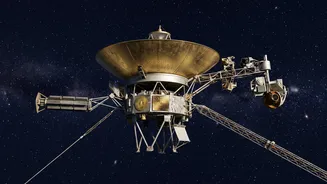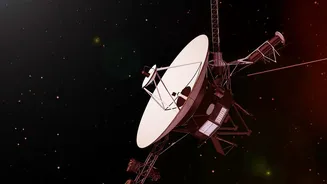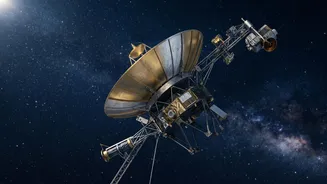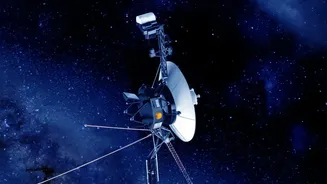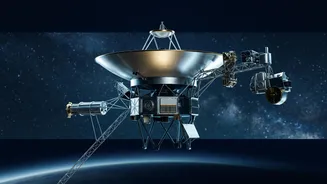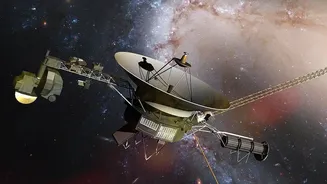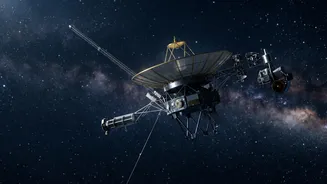



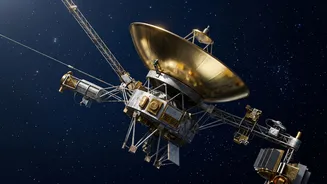
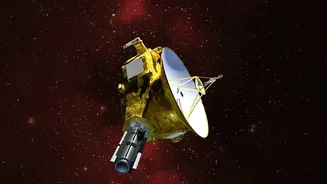
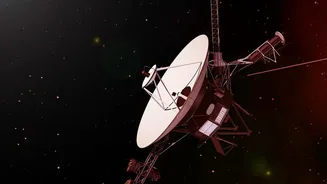
Humanity’s most distant emissary, Voyager 1, is talking to us again. After a tense, 48-hour silence that had engineers holding their breath, NASA has re-established contact, sparking both relief and a pressing investigation into the cause.
A Call from the Edge of the System
In mid-October,
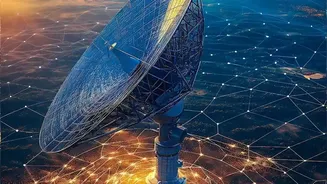
the unthinkable happened: Voyager 1 went quiet. For two full days, NASA’s Deep Space Network, a global array of massive radio antennas, listened for the faint signal from the probe and heard nothing. On October 18 and 19, two scheduled check-ins were met with silence. Then, on October 20, the signal returned on its own, before mission controllers at the Jet Propulsion Laboratory (JPL) could even send troubleshooting commands. The brief outage was a stark reminder of the challenges of operating a nearly 50-year-old spacecraft over 24 billion kilometers from home. Relief at JPL was immense, but it was immediately followed by the urgent question: what happened?
What Caused the Mysterious Silence?
Engineers are still piecing together the events that led to the brief communications blackout. So far, they have determined that the probe’s onboard fault-protection system automatically triggered, placing the spacecraft into a safe mode. This autonomous response appears to have been caused by one group of orientation thrusters going offline, which prompted a backup set to immediately take over. This programmed swap is designed to keep the spacecraft stable if the computers detect a problem. However, the underlying reason for the initial thruster issue remains under investigation. Adding to the mystery is the fact that the probe re-established contact on its own, a behavior the mission team has never seen before.
Troubleshooting at a Snail's Pace
Diagnosing and fixing a problem on Voyager 1 is a monumental exercise in patience. On November 18, the spacecraft will reach a historic milestone, becoming one light-day distant from Earth. This means a radio signal, travelling at the fastest speed possible, takes 24 hours to reach the probe. A full round-trip communication—sending a command and receiving confirmation—takes a minimum of two days. This incredible time lag forces engineers to be meticulously careful and creative, sending 'pokes' and analyzing memory readouts to understand the health of a machine that launched in 1977. Every command is a slow-motion conversation across the immense void of interstellar space.
The Constant Battle Against Fading Power
The recent communication scare unfolds against the backdrop of a larger, more inevitable challenge: dwindling power. Voyager 1 runs on radioisotope thermoelectric generators, which convert heat from decaying plutonium into electricity. But after nearly five decades, the power output declines by about 4 watts per year. To keep the mission alive, NASA has been forced to make difficult choices, methodically shutting down instruments and heaters. Just weeks before the outage, in September, engineers performed a delicate power_saving maneuver nicknamed the 'Big Bang,' simultaneously swapping three devices for lower_power alternatives to preserve heat and extend the life of the remaining science instruments. Without it, another instrument might have been shut down by 2027.
A Legacy That Transcends the Stars
Despite its age and the immense distances involved, Voyager 1 continues to send back invaluable data from interstellar space, the region beyond the protective bubble of our sun. It and its twin, Voyager 2, are the only human_made objects to ever reach this territory. While most of its instruments have been powered down, the few that remain are studying the nature of the interstellar medium, a realm humanity has never before directly sampled. But Voyager's legacy is more than just data. It is a testament to human ingenuity and our insatiable curiosity. As it silently sails through the cosmos carrying its Golden Record—a time capsule of Earth's sights and sounds—it remains our farthest ambassador, a lonely but resilient symbol of our reach for any stars.