


What Exactly Is This Cluster?
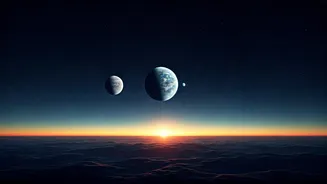
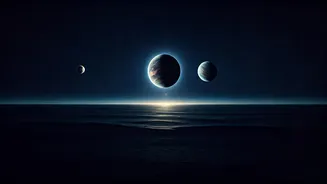
Tonight’s event is what astronomers call a planetary conjunction, but with a special twist. It involves not two, but three planets appearing incredibly close to each other from our vantage point on Earth. The planets aren't actually close together in space—they
remain millions of kilometres apart on their own orbits. However, their alignment in our line of sight creates a beautiful, temporary grouping in one small patch of the sky. This makes for a fantastic and easily observable celestial spectacle, a chance to see a dynamic part of our solar system in action.
The Three Stars of the Show
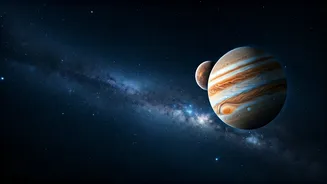
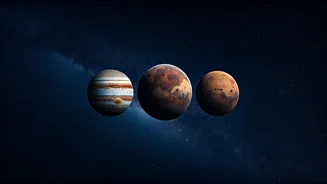
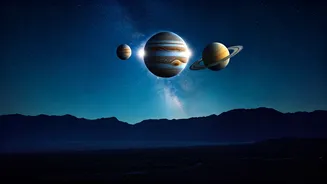
The trio gracing our skies tonight are three of the most fascinating planets in our solar system: Jupiter, Mars, and Saturn. * **Jupiter:** The king of planets. It will be the brightest of the three, shining with a steady, brilliant white light. Even with a simple pair of binoculars, you might be able to spot its four largest moons—Io, Europa, Ganymede, and Callisto—as tiny pinpricks of light flanking the giant planet. * **Saturn:** Famous for its stunning rings, Saturn will appear as a steady, yellowish-white point of light. While its rings aren't visible to the naked eye, its distinct colour makes it stand out. It will likely be the faintest of the three, but still clearly visible. * **Mars:** The Red Planet will live up to its name, appearing as a distinct, reddish-orange dot. Its colour is unmistakable and has captivated skywatchers for millennia. Mars’s brightness can vary depending on its distance from Earth, but in this cluster, its unique hue will be a dead giveaway.
Your Step-by-Step Viewing Guide
Seeing this event is simple. You don't need expensive equipment, just a clear view of the sky. Here’s how: 1. **Timing is Everything:** The best time to look is shortly after sunset. Aim for about 45 to 90 minutes after the sun has dipped below the horizon. This is when the sky is dark enough for the planets to shine brightly, but before they sink too low and disappear. 2. **Know Your Direction:** The cluster will be visible low in the western sky. Find the spot where the sun just set—that’s your target direction. Since they are low, a clear horizon free from tall buildings or trees is essential. 3. **Let Your Eyes Adjust:** Move away from bright lights and give your eyes at least 10-15 minutes to adapt to the darkness. This will make it much easier to spot the fainter planets and appreciate the view.
Do You Need a Telescope?
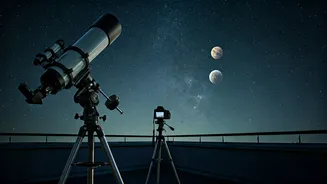
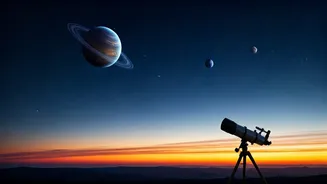
Absolutely not! All three planets—Jupiter, Saturn, and Mars—are bright enough to be seen with the naked eye, which is part of what makes this event so special. They will look like three unusually bright, non-twinkling 'stars' huddled together. However, if you have a pair of binoculars, bring them along. Binoculars will enhance the view significantly. You’ll be able to better appreciate the different colours of the planets and, as mentioned, you might even catch a glimpse of Jupiter's Galilean moons. A telescope would, of course, reveal even more detail, such as Saturn’s rings, but it's not a requirement to enjoy the show.
Why Is This Considered Rare?
While conjunctions between two planets are relatively common, having three bright planets gather in such a small area of the sky is a much less frequent occurrence. The orbits of the planets are all on slightly different planes and move at different speeds, so for them to align so perfectly from our perspective is a matter of celestial geometry and chance. It's a fleeting gathering that reminds us of the constant, silent dance of the planets. It’s these rare alignments that have captivated astronomers and casual skywatchers for centuries, offering a moment to connect with the grand scale of our cosmic neighbourhood.