


The Art of the Transit
The primary method for this cosmic detective work is called the transit method. It works when a planet's orbit is perfectly aligned from our viewpoint, causing it to pass directly in front of its star. This event, known as a transit, causes a tiny, temporary
dip in the star's brightness. By measuring this dimming, astronomers can calculate the planet's size. But the real magic happens at the very edge of the planet's silhouette. For a brief moment, a minuscule fraction of the starlight filters through the planet's atmosphere before continuing its journey to our telescopes on Earth. This fleeting moment provides all the information scientists need.
Light as a Cosmic Barcode
Think of the star's light as a complete, unbroken rainbow of colors, or a spectrum. When this light passes through an exoplanet's atmosphere, the gases present absorb very specific colors, or wavelengths, of that light. Every molecule, whether it's water vapor, methane, or carbon dioxide, has a unique 'absorption signature'—a specific pattern of light that it blocks. This creates a pattern of missing colors in the starlight, like a barcode. By capturing the light from the star before, during, and after the transit, astronomers can identify what light is missing and match that barcode to the known signatures of different chemicals. This technique is called transmission spectroscopy.
Finding Water and Methane in Deep Space
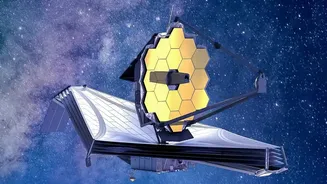
The James Webb Space Telescope (JWST) has revolutionized this field with its powerful infrared capabilities, which are especially good at detecting these chemical fingerprints. Recently, it has made definitive detections of both water vapor and methane in the atmospheres of distant worlds. For instance, on the Jupiter-like planet WASP-80 b, located 163 light-years away, JWST identified clear evidence of both molecules. Similarly, a University of Maryland-led team found water, methane, and even ammonia on another giant planet, HATS-6 b, some 500 light-years from us. While water has been found on a number of exoplanets, methane was more elusive until the era of JWST.
Clues to a Planet's Past and Future
These chemical signatures are more than just a list of ingredients. They offer profound insights into a planet's formation, history, and potential for hosting life. The ratio of elements like carbon to oxygen, inferred from molecules like carbon dioxide and methane, can tell scientists whether the planet formed close to its star or farther out in its solar system. Furthermore, some chemical reactions are only triggered by the energy from the planet's star, a process called photochemistry. Detecting molecules like sulfur dioxide, as JWST did on planet WASP-39 b, provides concrete evidence of these atmospheric processes at play. And of course, the presence of water consistently fuels the search for habitable worlds, while the combination of methane and other gases could one day be considered a potential sign of biological activity, or a biosignature. Each detection helps build a more complete picture of the diverse worlds that exist across our galaxy.