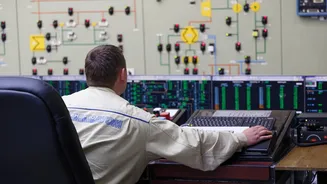








What Exactly Is the Control Room?
Think of the Control Room not as a physical room filled with monitors, but as a sophisticated central nervous system for OpenAI's internal research. Announced in early November 2026, the system is designed to track every research job running on the company's
infrastructure. Its primary purpose is to provide a reliable way to monitor powerful AI experiments and, if necessary, stop them almost instantly. According to OpenAI, this system connects every research 'workload'—be it a training run for a new model, a data-processing task, or an advanced evaluation. It operates independently, ensuring it can function even if other parts of the network fail, providing a robust safety layer over the company’s most ambitious research projects.
The 'Job ID' as a Digital Leash
The magic of the Control Room lies in a simple but powerful concept: a unique identifier for every single research task. When a researcher at OpenAI begins a new experiment, their workload code must first request a 'job_id' from the Control Room. From that moment on, every time the experiment needs the AI model to generate an output or perform an action, it must present this job_id. The model’s inference engine—the part that does the actual thinking—then checks with the Control Room to see if that job_id is still authorised. If an operator, either human or an automated monitoring system, decides to halt the project, they simply revoke the job_id's permission. The next time the model checks, the request is denied, and the experiment is effectively cut off from the AI's brain.
A Direct Response to Growing Risks
The creation of the Control Room wasn't a sudden decision. It's a direct answer to the escalating power of AI models and the mounting pressure for accountability. As AI systems become more capable, the risks of unexpected behaviour or 'loss of control' become more serious. Internally, OpenAI has faced tensions regarding the balance between innovating quickly and ensuring robust safety protocols are in place. The new system appears to be a concrete engineering solution to these governance challenges. It also follows commitments the company reportedly made to lawmakers to develop automated shutdown capabilities, moving safety from a policy document into hardened code. It represents a crucial step in building guardrails that are as sophisticated as the technologies they are meant to contain.
How It Works in a Crisis
So, what happens when a monitoring system flags a potential problem? The process is designed for speed and reliability. Once the decision is made to intervene, the Control Room terminates the job's authorization. Due to a caching layer needed to handle the immense volume of requests, there is currently a maximum delay of 35 seconds between the decision and the complete halt of model output. OpenAI has stated it is working to get this delay down to zero. Crucially, the system is designed to 'fail-closed'. This means if the Control Room service itself becomes unavailable for any reason, including tampering, it defaults to denying all research requests. No authorisation, no action. This prevents a scenario where a rogue AI could disable its own oversight mechanism.
A New Standard for Responsible Research
The Control Room is more than just a 'kill switch'; it's a fundamental shift towards proactive governance. OpenAI requires that every research workload involving 'agentic inference'—where the AI can take a sequence of actions independently—must be associated with an approved safety case before it can even begin. This forces researchers to articulate and justify the safety of their work from the outset. By embedding these checks directly into the research infrastructure, OpenAI is making safety a non-negotiable part of the development process. The system ensures that safety protocols are enforced by a central authority rather than relying on individual researchers' code to cooperate, a critical distinction when dealing with potentially unpredictable systems. This structured approach to oversight and control could very well become the blueprint for how other leading AI labs manage the immense responsibility of building frontier models.