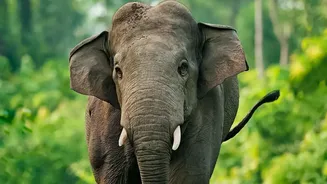



When we picture an elephant, we often imagine a majestic giant with grand, curving tusks. But this image largely fits African elephants. For their Asian cousins, especially females, the story is quite different, revealing a fascinating mix of genetics.
A Tale of Two Species
The most significant reason for the tusk difference comes down to species. In African elephants, both males and females typically grow long, prominent tusks. These are used for everything from defence and digging for water to stripping bark from trees. In Asian elephants, however, there is a strong distinction between the sexes. While many male Asian elephants have large tusks, it is a predominantly male characteristic. The majority of female Asian elephants do not have large, visible tusks. Instead, many possess small, peg-like teeth called 'tushes', which rarely protrude beyond their lip line and are often not visible at all.
What Exactly Are Tusks?
Elephant tusks are not horns; they are actually massively elongated incisor teeth that grow continuously throughout the animal's life. Composed of a dense bony tissue called dentin, which we know as ivory, about a third of the tusk is hidden inside the elephant's skull, embedded in a deep socket full of nerves and blood vessels. This makes them incredibly strong tools but also highly sensitive. Just like humans tend to be right- or left-handed, elephants are often right- or left-tusked, with their dominant tusk usually showing more wear and tear from frequent use.
The Genetic Blueprint
For Asian elephants, tusklessness in females is a natural, genetically-driven trait. The specific genes that trigger the growth of large tusks are primarily activated in males. Even among males, there is significant variation. Some male Asian elephants, particularly in regions like Sri Lanka and Southern India, are naturally tuskless and are known as 'makhnas'. They are physically larger than females but lack the impressive ivory of other bulls. For females, having small tushes or no tusks at all is the biological norm, a trait that has likely evolved over millions of years based on social structure, habitat, and dietary needs.
A Human-Driven Evolutionary Push
While tusklessness in female Asian elephants is natural, human activity has dramatically amplified this trait through the brutal pressure of ivory poaching. For centuries, elephants with large tusks have been targeted by hunters. This creates a powerful evolutionary force: elephants without tusks are more likely to survive and reproduce, passing on their tuskless genes to the next generation. In heavily poached areas, the frequency of tusklessness has increased in both Asian and African elephant populations. Studies on African elephants in Mozambique, for instance, showed that after a period of intense civil war where 90% of elephants were killed for ivory, the proportion of tuskless females in the next generation rose dramatically. This is a stark example of human-driven evolution, where our actions are rapidly reshaping the anatomy of another species.
The Hidden Costs of Tusklessness
Surviving poaching is a clear advantage, but life without tusks comes with its own set of challenges. Elephants use tusks as essential tools for survival, helping them access food, water, and minerals. Losing them can alter an elephant's diet and behaviour. Furthermore, some of the same genetic mutations linked to tusklessness in female elephants have been found to be fatal to male offspring in the womb. This could potentially skew the sex ratio in recovering populations, slowing down their growth. While the absence of tusks may protect an individual elephant from a poacher's bullet, it may introduce new, long-term vulnerabilities for the species as a whole, affecting not just the elephants but also the ecosystems they help shape.