




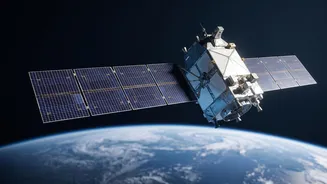
The Current Bottleneck in the Sky
For decades, the model for satellite operations has been simple: act as a camera in the sky. Satellites collect vast amounts of raw data—from high-resolution imagery to radio frequency signals—and beam it all down to ground stations on Earth. This “bent
pipe” model, where the satellite is just a relay, has served us well, but it is now hitting its limits. The number of active satellites is projected to triple by 2030, and the sophistication of their sensors means we are generating data far faster than we can downlink it. The result is a cosmic traffic jam. Limited bandwidth, reliance on ground station availability, and high latency mean it can take hours or even days for critical information to get from the satellite to the analyst who needs it. This delay makes real-time applications nearly impossible.
A Smarter Approach: Edge Computing in Space
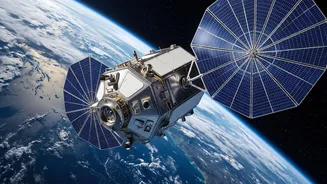
A new paradigm is emerging to solve this data deluge: in-orbit computing. Also known as edge computing for space, the idea is to process data where it is collected—on the satellite itself. Instead of a simple relay, the satellite becomes an intelligent node in a network. Think of it like a smartphone. Rather than sending raw sensor data to the cloud every time you take a photo, your phone processes the image locally to adjust color and focus. Similarly, satellites equipped with powerful processors, like GPUs, can run artificial intelligence and machine learning algorithms directly in orbit. This allows them to analyze imagery, filter out irrelevant data (like cloud-covered photos), and identify important events on their own. As a result, they can send back compact, actionable insights instead of massive raw files.
From Data Relay to Real-Time Insight
The benefits of this shift are transformative. For disaster response, a satellite could detect the start of a wildfire and send an immediate alert to emergency services, rather than waiting for a large image file to be downloaded and analyzed. In agriculture, an orbital system could monitor crop health across thousands of acres and send back a concise report on areas needing water or fertilizer. For national security, onboard AI can enable real-time threat detection and tracking without ground intervention. Tech giants and aerospace companies are already pioneering this field. HPE's Spaceborne Computer-2, tested on the International Space Station, demonstrated the feasibility of running complex AI workloads in space. In one experiment, it processed 22GB of raw DNA sequencing data onboard, reducing it to a 235KB file of results, dramatically cutting down transmission time. Similarly, initiatives like Microsoft's Azure Space are building the infrastructure to connect satellites to cloud computing resources, enabling everything from AI-driven analytics to autonomous satellite operations.
The Challenges of a Cosmic Data Center
Moving the data center to orbit is not without significant hurdles. Space is an incredibly harsh environment. Without the protection of Earth's atmosphere, electronics are bombarded with radiation that can corrupt data and damage hardware. Cooling is another major issue; in the vacuum of space, the immense heat generated by processors must be dissipated through large, fragile radiators to prevent the systems from melting. Furthermore, power is limited to what can be generated by solar panels. And unlike a terrestrial data center, you can't just send out a technician to swap a faulty component. Every piece of hardware must be incredibly reliable, and any software updates have to be performed remotely, a complex and risky procedure. The costs are also, for now, astronomical compared to ground-based solutions.