



Let's Define Our Terms: Day vs. Year
Before we dive into the strangeness of Venus, let's establish our baseline: Earth. For us, the concepts of a 'day' and a 'year' are simple and distinct. A year is the time it takes Earth to complete one full orbit around the Sun, roughly 365 days. A day is the time it takes for our planet
to complete one full rotation on its own axis, about 24 hours. This spin is what gives us the cycle of day and night. On Earth, we fit many, many spins (days) into one single trip around the Sun (a year). This relationship feels natural and obvious to us, but the cosmos has other ideas.
Welcome to Venus, the Rule Breaker
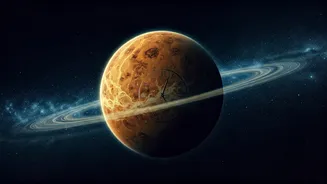
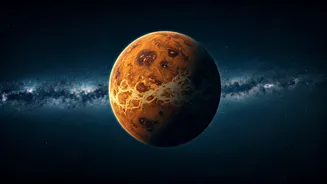
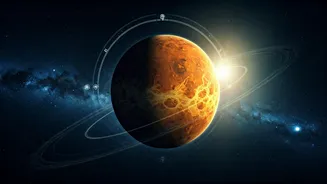
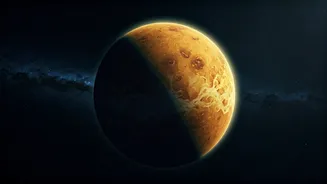
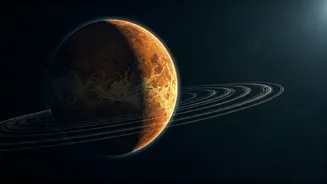
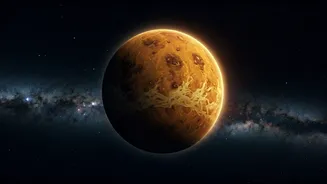
Now, let’s travel to Venus. Often called Earth’s “twin” because of its similar size and composition, Venus is anything but identical in its behaviour. The first major difference is its rotation. While Earth and most other planets in our solar system spin counter-clockwise, Venus spins clockwise. This is known as retrograde rotation. It’s essentially spinning backwards. Secondly, and most importantly for our headline, its spin is incredibly slow. It crawls along, taking an astonishingly long time to complete a single turn.
The Mind-Bending Numbers
Here's where it gets truly weird. A 'year' on Venus—the time it takes to orbit the Sun—is about 225 Earth days. This is faster than Earth’s 365-day orbit because Venus is closer to the Sun. Now for the 'day'. A sidereal day on Venus—the time it takes for one full 360-degree rotation on its axis—is approximately 243 Earth days. Read that again: it takes 243 Earth days for Venus to spin around just once. This means you would celebrate your first Venusian birthday before a single Venusian 'day' has even finished.
A Day That Outlasts a Year
This is the heart of the paradox. Because its rotational period (243 Earth days) is longer than its orbital period (225 Earth days), the headline is factually correct. A single spin of the planet takes more time than its entire journey around the Sun. If you were standing on Venus, the stars in the sky would take 243 Earth days to return to their exact same position from your perspective. It's a concept so alien to our experience that it highlights the sheer diversity of planetary mechanics in our own solar system.
A Complication: The 'Solar Day'
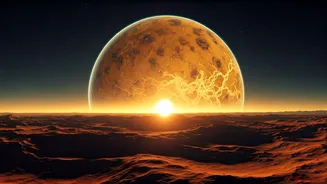
To add another layer of strangeness, there's another way to measure a day: the 'solar day'. This is the time it takes for the Sun to appear in the same spot in the sky—what we’d experience as the period from one sunrise to the next. Because Venus is rotating backwards while it orbits the Sun, these two motions work against each other in a unique way. The result is a solar day on Venus that is about 117 Earth days long. So, while a full spin takes 243 days, the sun would rise and set roughly twice per Venusian year. It's still an incredibly long time to wait for morning to come.
Why Is Venus So Weird?
Scientists don't have a definitive answer for why Venus spins so slowly and backwards, but there are a few leading theories. One popular idea is that Venus was struck by a massive object, perhaps another planetoid, billions of years ago. Such a cataclysmic impact could have been powerful enough to reverse its original spin and dramatically slow it down. Another theory suggests that the planet's incredibly thick and dense atmosphere created so much friction against its surface over billions of years that it acted as a brake, gradually grinding its rotation to the slow, backward crawl we see today. The truth may be a combination of these factors, and it remains a fascinating mystery for planetary scientists to solve.