






What Exactly Did Hubble Discover?
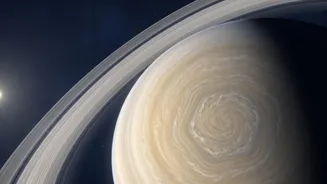
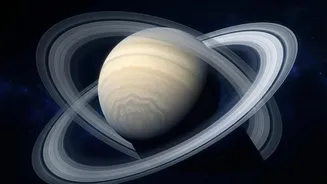
Recent images from the Hubble Space Telescope have confirmed the presence of a massive, evolving, 10-sided atmospheric wave around Saturn's south pole. This feature, which scientists are calling a decagon, is the first time such a large, regular-sided
pattern has been spotted in the planet's southern hemisphere. It's not a solid object, but rather a wave within the planet's powerful jet streams, creating a distinct geometric shape in the clouds. By studying archival images, researchers traced the first faint signs of this structure back to 2023. Observations in subsequent years showed the pattern becoming more defined, suggesting scientists are witnessing a new atmospheric phenomenon as it develops. This is a rare opportunity, as these features often exist for decades or centuries before we even notice them.
A Planet of Puzzling Polygons
This discovery is particularly exciting because Saturn is already home to one of the most famous geometric oddities in the solar system: a persistent hexagonal cloud pattern at its north pole. Discovered during the Voyager mission in the 1980s, the northern hexagon has remained remarkably stable for over 40 years. For a long time, it was considered a unique feature. The emergence of a ten-sided counterpart at the opposite pole suggests that the formation of such polygons might be a more fundamental characteristic of Saturn's atmosphere than previously believed. However, the two are not identical. The new decagon is located at a different latitude than the hexagon and appears to be less stable, given that it seems to have formed only recently.
How Can a Planet Have Geometric Storms?
It seems unnatural for a chaotic atmosphere to create a neat, ten-sided shape, but the physics of gas giants makes it possible. Saturn has no solid surface like Earth, and its atmosphere is much more uniform. This allows powerful, fast-moving jet streams to flow without the disruption caused by mountains or oceans. Scientists believe these polygonal shapes are a type of atmospheric wave that gets locked into a stable pattern by the jet stream. Laboratory experiments using rotating tanks of fluid have successfully recreated similar polygonal shapes, suggesting that instabilities and gradients in wind speed can cause these patterns to emerge naturally. The number of sides—six for the hexagon, ten for the decagon—is thought to be related to the specific properties of the jet stream, such as its speed and width.
Why This Discovery Matters
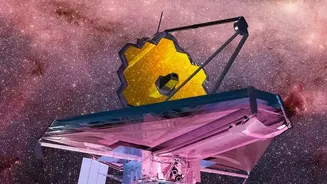
This evolving decagon is more than just a cosmic curiosity. Since it appears to be a new development—NASA's Cassini spacecraft, which orbited Saturn from 2004 to 2017, saw no signs of it—it gives scientists a rare chance to study the birth of a massive atmospheric structure in near real-time. The feature also extends deep into the planet's atmosphere, through multiple cloud layers. This vertical structure provides a window into the dynamics of Saturn's interior, helping scientists understand how energy and weather patterns move through the gas giant's immense and hidden depths. Studying how and why this decagon formed could unlock key insights into the behaviour of atmospheres on all giant planets. Further observations are planned with both Hubble and the James Webb Space Telescope to monitor its evolution.