
Understanding 'Tech Neck'
Before diving into the solutions, it helps to understand the problem. 'Tech neck' refers to the stress and strain on the cervical spine from looking down at electronic devices for prolonged periods. This forward head posture forces the muscles in your
neck, shoulders, and upper back to work overtime to support your head, which can feel much heavier in that position. Over time, this leads to muscle imbalances: the chest muscles tighten, and the upper back muscles become weak and overstretched. The result is the tell-tale rounded shoulders, forward-jutting chin, and persistent stiffness that so many of us experience.
Cat-Cow Pose (Marjaryasana-Bitilasana)
This gentle, flowing movement is a perfect starting point for releasing spinal tension. It improves flexibility in the neck, shoulders, and spine, and encourages healthy alignment. To begin, get on all fours in a 'tabletop' position, with your hands directly under your shoulders and your knees under your hips. As you inhale (the 'Cow' part), drop your belly towards the mat, lift your chest and tailbone, and look forward. As you exhale (the 'Cat' part), round your spine toward the ceiling, tucking your chin to your chest and pressing the floor away with your hands to feel a stretch between your shoulder blades. Repeat this fluid movement for 8-10 breaths, syncing your breath with the motion.
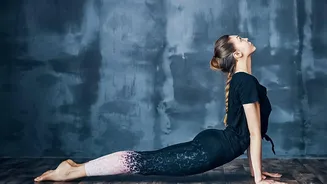
Cobra Pose (Bhujangasana)
Cobra Pose is a foundational backbend that directly counteracts the forward slump of tech neck. It strengthens the spine, stretches the chest and shoulders, and helps to retrain the body to sit and stand taller. Lie on your stomach with your legs extended and the tops of your feet on the floor. Place your hands under your shoulders, keeping your elbows tucked in close to your body. Pressing gently into your hands, inhale and lift your head, chest, and shoulders off the floor. Keep your gaze forward and your neck as a natural extension of your spine. Hold for a few breaths, feeling the opening across your chest, and then exhale as you slowly lower back down. It’s a powerful move for restoring the natural curve of your spine.
Cow Face Pose Arms (Gomukhasana)
This pose provides a deep stretch for tight shoulders, the triceps, and the chest—all areas affected by poor posture. You can do this seated or standing. Reach your right arm straight up, then bend the elbow so your right hand is behind your back, as if patting yourself on the back. Next, reach your left arm behind your back from below, aiming to clasp the fingers of your right hand. Many people's shoulders are too tight for this, which is perfectly normal. If you can't clasp your hands, simply hold onto a strap, a towel, or even the hem of your shirt with both hands. Hold for 30 seconds, breathing into the stretch, then gently release and switch sides.
Thread the Needle Pose (Urdhva Mukha Pasasana)
An excellent posture for releasing tension, Thread the Needle opens the shoulders and upper back while providing a gentle spinal twist. Start on all fours. On an exhale, 'thread' your right arm underneath your left, bringing your right shoulder and the side of your head to rest on the mat. Your hips should remain lifted high. To deepen the stretch, you can gently press into your left hand or walk it forward. Hold here for several deep breaths, feeling the release in your right shoulder blade and upper back. To exit, press into your left hand to unwind, and repeat on the other side.
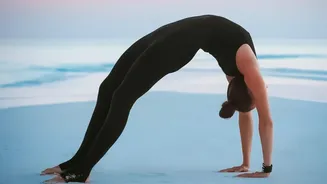
Bridge Pose (Setu Bandhasana)
Bridge Pose is a restorative backbend that helps counteract the effects of prolonged sitting and slouching. It strengthens the back of your body (glutes and hamstrings) while opening the front of your body (chest and shoulders). Lie on your back with your knees bent and feet flat on the floor, hip-width apart. Your arms should be alongside your body with palms down. On an exhale, press through your feet and arms to lift your hips off the floor. Try to clasp your hands together on the mat beneath your pelvis and roll your shoulders underneath you to create more space across your chest. Keep your thighs parallel and hold for 30 seconds before slowly rolling down.