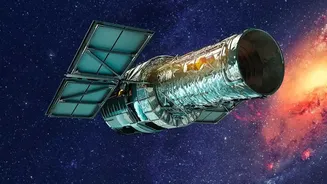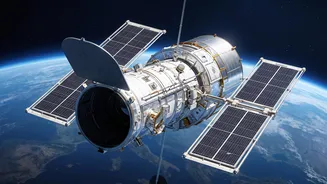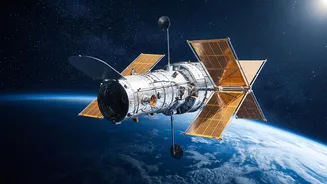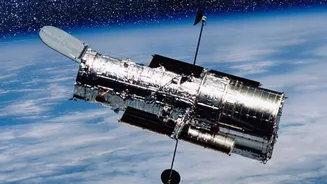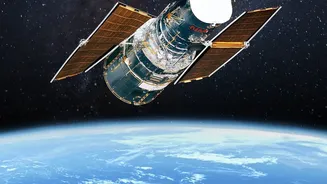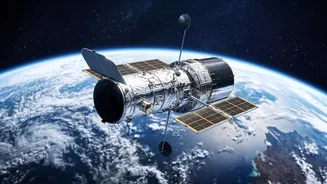



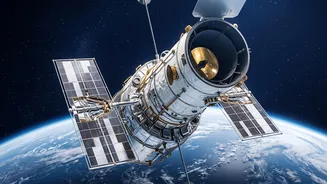
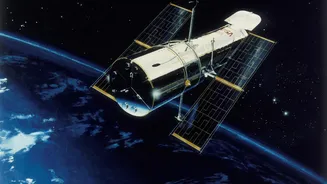
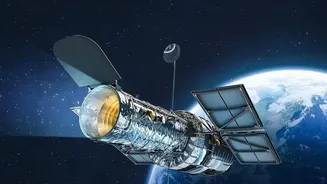
For over 35 years, the Hubble Space Telescope has been humanity's window to the cosmos, but it's showing its age. NASA is now carefully exploring how to keep this icon alive, turning to private industry for ideas before committing to a rescue.
A Legend's Slow Decline
The Hubble
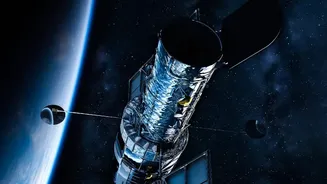
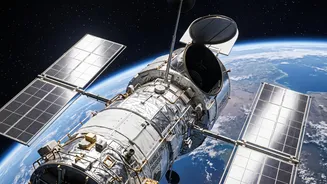
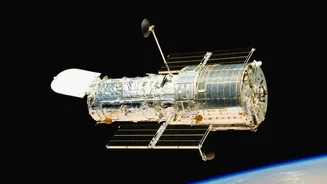
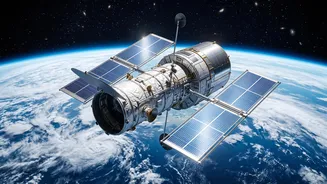
Space Telescope is not broken, but it is facing two significant, age-related challenges. The first is its pointing system. To aim with pinpoint accuracy, Hubble uses gyroscopes—spinning wheels that measure its rate of motion. These have been a persistent issue; multiple sets were replaced by astronauts during the Space Shuttle era. Since the final servicing mission in 2009, the gyros have been failing. In mid-2024, after another gyro gave consistently faulty readings, NASA transitioned Hubble to a long-planned 'one-gyro mode' to conserve the remaining functional units. This keeps the telescope working but makes it slower to pivot to new targets, affecting observational efficiency. The second, more pressing issue is orbital decay. Hubble has no engine of its own. Atmospheric drag, though minuscule at its altitude, is slowly pulling the telescope closer to Earth. Without a push into a higher orbit, it is projected to make an uncontrolled re-entry into the atmosphere sometime in the mid-2030s.
Testing the Waters, Not Placing Bets
Instead of announcing a grand, government-funded rescue mission, NASA issued a 'Request for Information' (RFI) in late October 2026. This is a standard but crucial step in the world of government procurement. An RFI is not a contract or a promise to buy anything. It's a form of market research. NASA is essentially asking the booming commercial space industry: 'What ideas do you have, how would you do it, and what might it cost?'. The RFI asks companies for concepts on three possibilities: boosting Hubble to a higher, more stable orbit; servicing it to enhance its systems; or, as a final option, guiding it to a safe, controlled de-orbit at the end of its life. This approach allows NASA to gauge technical readiness and innovative, cost-effective solutions without making a massive financial commitment upfront, especially since no funds are currently allocated for a Hubble rescue mission.
The Commercial Cavalry
The idea of a private-sector rescue is not new. In 2022, NASA and SpaceX signed an unfunded agreement to study the feasibility of using a SpaceX Dragon capsule for a reboost mission. That study was part of the Polaris Program, a series of private astronaut missions funded by billionaire Jared Isaacman. The Polaris proposal involved not just pushing Hubble into a higher orbit, which could add 15 to 20 years to its life, but also potentially servicing it. However, internal discussions revealed NASA's concerns about the risks, especially regarding the technical readiness for complex spacewalks using unproven commercial spacesuits. NASA's new RFI officially opens the door for other companies to submit their own architectures, which could involve robotic tugs or other spacecraft, not just a crewed mission. This formalizes the process and widens the pool of potential saviors beyond the initial SpaceX concept.
What's at Stake for Science
Losing Hubble would be a tremendous blow to science. Even with the incredible success of the James Webb Space Telescope (JWST), the two observatories are complementary, not interchangeable. Hubble is unmatched in its ability to see in ultraviolet and visible light, wavelengths that Webb is not designed to capture. This unique capability means Hubble is still in high demand, producing over 1,000 scientific papers a year. Researchers have already outlined ambitious projects for Hubble into the 2030s, including studies of exoplanet atmospheres and distant galaxies. Extending its life would bridge a critical gap, as the next flagship observatory with similar capabilities, the Habitable Worlds Observatory, isn't planned to be operational until the 2040s. The science community and the public have a vested interest in keeping Hubble's unique eyes on the universe for as long as possible.