


Into the Cosmic Fog
For hundreds of millions of years after the Big Bang, the universe was a dark, foggy place. It was filled with a thick haze of neutral hydrogen gas that absorbed energetic light, making it impossible to see the first stars being born. This period is often
called the Cosmic Dark Ages. The Cosmic Dawn marks the end of this era, a pivotal moment when the very first stars and galaxies ignited, beginning a process called reionization. Their intense radiation started to burn through the hydrogen fog, like countless tiny lighthouses clearing a cosmic mist, transforming the universe from opaque to the transparent, star-filled expanse we know today.
The Unexpectedly Bright Trailblazers
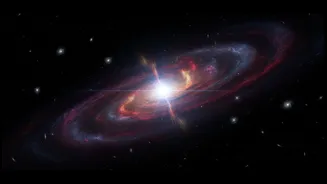
For years, theories suggested that the first galaxies were small and faint. However, recent observations from the James Webb Space Telescope (JWST) are challenging these assumptions in a spectacular way. Astronomers are discovering galaxies from this early period that are shockingly large and luminous, far brighter than models predicted. One such record-breaker, JADES-GS-z14-0, existed when the universe was less than 300 million years old, yet it shines with the light of an estimated 500 million suns. These ancient objects are not just one-offs; a growing number of these unusually bright galaxies suggest that star formation in the early universe was far more rapid and efficient than previously thought.
A New Golden Eye on the Universe
These groundbreaking discoveries are possible thanks to the unparalleled power of the James Webb Space Telescope. As the universe expands, the light from these incredibly distant objects gets stretched into longer, redder wavelengths—a phenomenon called redshift. Light that was originally ultraviolet or blue from these first stars has travelled for over 13 billion years and arrives at our telescopes as infrared light. The JWST is specifically designed to capture this faint, ancient infrared glow with a sensitivity that has revolutionised the study of the early cosmos, allowing scientists to not just find these galaxies, but to analyze their chemical makeup and age. The discovery of elements like oxygen suggests some of these galaxies were already old enough to be witnessing their second or third generation of stars.
Rewriting Our Cosmic Origin Story
The existence of these bright, massive galaxies so early in cosmic history is creating a “growing chasm between theory and observation,” according to researchers. It forces a major rethink of how quickly the first structures could form. Some evidence suggests that many of these early light sources were abundant, low-mass dwarf galaxies that were collectively punching above their weight, producing four times the ionizing radiation previously assumed. Other discoveries point to massive galaxies growing rapidly through mergers. These findings don't just solve old mysteries; they open up new, compelling questions. How did these galaxies accumulate so much gas to fuel such rapid star birth? And what does this tell us about the seeds of the supermassive black holes found at the center of most large galaxies today, including our own Milky Way?