
The Sun’s Trillion-Dollar Threat
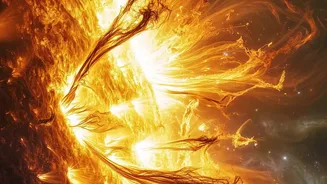
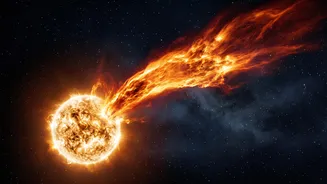
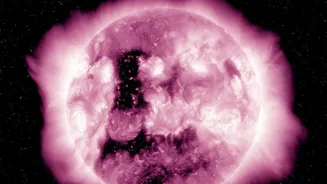
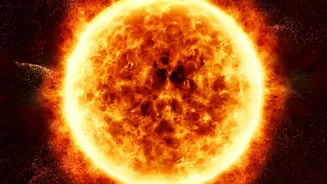
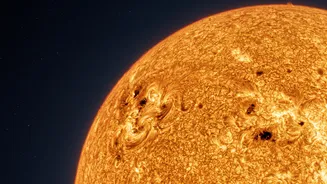
A solar storm, or more specifically a coronal mass ejection (CME), is a massive explosion in the Sun's atmosphere that hurls plasma and magnetic fields into space. If one of these is aimed at Earth, it can have catastrophic consequences for our technology-dependent
society. The most famous example, the Carrington Event of 1859, set telegraph stations on fire. A similar event today would be far more devastating. Studies have estimated that a severe geomagnetic storm could cause daily economic losses in the tens of billions of dollars, with some models projecting total global economic losses in the trillions. The danger lies in the storm's ability to induce powerful electrical currents in our power grids, potentially frying transformers and causing widespread, long-lasting blackouts. Satellites responsible for GPS, communications, and financial transactions are also highly vulnerable. It’s a matter of when, not if, the next big one will hit.
The Challenge of Watching the Sun
Traditionally, forecasting a solar storm is a reactive process. Scientists use satellites to constantly monitor the Sun. When they physically see a CME erupt and determine it’s heading our way, the clock starts ticking. Depending on the storm's speed, this gives us anywhere from about 12 hours to a few days of warning. While this is better than nothing, it’s not enough time to adequately protect our most critical infrastructure, a process that can involve methodically powering down sections of the grid. We are essentially watching a cannonball after it has already been fired, trying to calculate its path. The real game-changer would be to know when the cannon is about to be fired in the first place. This is where the limitations of human analysis become clear and the potential for AI emerges.
AI for a 30-Minute Warning
The first wave of AI-powered tools is already in action, focusing on the final, crucial moments before a storm’s impact. A model called DAGGER (Deep Learning Geomagnetic Perturbation), developed through a NASA-led partnership, provides a 30-minute advance warning of where a storm will strike and how severe its effects on the ground will be. Instead of watching the Sun 93 million miles away, DAGGER analyzes real-time data from solar wind monitors positioned much closer to our planet. By recognizing patterns in this data, the AI can predict the specific geomagnetic disturbances about to hit anywhere on Earth with remarkable speed and precision. This 30-minute window is like a tornado siren for grid operators and satellite controllers, offering just enough time to brace for impact and take immediate protective measures.
The Holy Grail: Predicting the Eruption Itself
While a 30-minute warning is a significant achievement, the ultimate goal is to move from short-term reaction to long-range prediction. This is the next frontier for AI in space weather. Research groups are now training AI models to analyze the vast and complex data streams from solar observatories, looking for the subtle precursors that signal an impending eruption. Recently, a model called EarlyDetect demonstrated the ability to spot the faint magnetic and acoustic signals of a developing active region nearly nine hours before it becomes visible. By learning to identify the tell-tale signs of magnetic field instability on the Sun's surface—patterns that are often too faint or complex for human analysts to spot—these systems aim to forecast the launch of a CME itself. Another model, named Surya, has shown it can predict solar flares up to two hours in advance, a significant improvement on previous methods.
From Hours to Days?
The promise of this research is to transform our warning capabilities, extending the lead time from hours to days. Organizations like the Frontier Development Lab, a public-private partnership with NASA, are focused on this very challenge. An AI that could reliably give two or three days' notice would be revolutionary. It would allow utility companies to reconfigure grids, satellite operators to place their spacecraft into a safe mode, and airlines to reroute flights away from polar regions where radiation exposure is higher during a storm. This isn't just about avoiding damage; it's about building a resilient global infrastructure. We are moving from simply forecasting a storm's arrival to predicting its birth, giving society the one thing it needs most: more time to prepare.
The Road Ahead Is Not Without Challenges
Despite the immense promise, AI is not yet a perfect crystal ball for solar weather. One of the biggest challenges is data. Machine learning models need vast amounts of historical data to train on, but we have very limited data for catastrophic-level storms like the Carrington Event. An AI can’t learn to recognize something it has never seen. Furthermore, the physics of the Sun are incredibly complex, and researchers are still working to ensure these AI models are not just spotting correlations but truly understanding the underlying causes. False alarms are also a concern; taking a power grid offline is a costly and disruptive measure, so the reliability of any forecast must be exceptionally high. Building trust in these automated systems and integrating them into global operational frameworks is a critical next step.