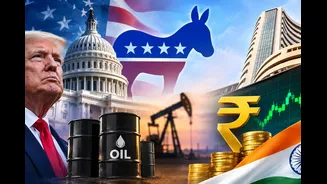








Understanding the Global Connection
At its core, 'US trade dialogue' refers to ongoing negotiations between the United States and its trading partners, including India, about the rules of commerce. These talks cover everything from tariffs (taxes on imported goods) to market access and trade standards.
Recent discussions have seen a flurry of activity, with officials navigating complex issues. For instance, reports in mid-October 2026 noted that while India's Finance Minister expressed optimism about a trade agreement, progress has hit hurdles. These negotiations create uncertainty, and global financial markets react to every hint of progress or friction. The stability and strength of the US dollar, the world's primary reserve currency, are often tied to the perceived direction of American economic policy.
From Washington to the Rupee's Value
The value of the Indian Rupee (INR) against the US Dollar (USD) is determined by supply and demand. When international investors feel confident about the US economy, they tend to buy dollar-denominated assets, strengthening the dollar. Conversely, uncertainty over US trade policy, such as sudden tariff changes or stalled negotiations, can cause volatility. A stalled US-India trade pact has been a significant factor influencing the rupee. For India, a weaker rupee means it takes more rupees to buy one dollar. As of October 2026, the rupee has seen significant fluctuation, trading in a range around the 95 to 97 mark against the dollar, influenced by central bank actions and global sentiment.
The Direct Impact on Import Costs
India is heavily dependent on imports for several key commodities, most notably crude oil, electronic components, and machinery. Since most international trade is priced in US dollars, a weaker rupee automatically makes these imports more expensive. Consider crude oil, which makes up a substantial portion of India's import bill. Even if the global price of oil remains stable, a drop in the rupee's value means oil companies in India have to pay more rupees for the same barrel of oil. This increased cost is a major driver of the country's trade deficit and has a direct knock-on effect on the wider economy.
How This Affects Your Wallet
The journey from a Washington trade talk to your monthly budget is surprisingly short. The most immediate and noticeable impact is at the fuel pump. Higher import costs for crude oil almost always translate into higher prices for petrol and diesel for consumers. But it doesn't stop there. The smartphone or laptop you've been eyeing is likely assembled with components imported from abroad. A weaker rupee increases the cost for manufacturers, a price hike that is often passed on to the consumer. Even the cost of edible oils and other imported food items can rise. Essentially, any product that relies on imported raw materials or parts becomes more expensive when the rupee weakens against the dollar.
What to Watch for Next
Currently, the US-India trade negotiations appear to be at a cautious stage. A recent visit by the US Secretary of State to India focused on investment and energy, but the broader trade deal remains elusive. The uncertainty around US tariff policies has been a key sticking point. For the Indian consumer, this means the exchange rate is likely to remain sensitive to global developments and news from these trade talks. The Reserve Bank of India (RBI) has been actively intervening to support the rupee through various measures, which has helped provide some stability. However, sustained rupee strength will likely depend on a clearer path forward in global trade relations and a stable inflow of foreign investment.