



The 'Universe Breakers'
Shortly after Webb started sending back its first images, astronomers noticed something strange scattered across the deepest fields of view: hundreds of tiny, reddish specks of light. These weren't just any celestial bodies; they existed in the universe's
infancy, just 600 million to a billion years after the Big Bang. The problem was their brightness. Initial interpretations suggested they could be incredibly massive galaxies, perhaps even larger than our own Milky Way. This was a huge contradiction, as there simply shouldn't have been enough time or matter in the early universe to form such galactic giants so quickly. The discovery was so perplexing that some astronomers dubbed these objects 'universe breakers', as they seemed to defy the standard model of cosmology.
A New Class of Object
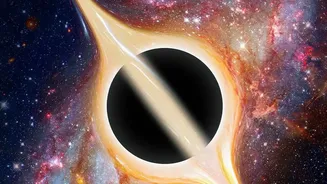
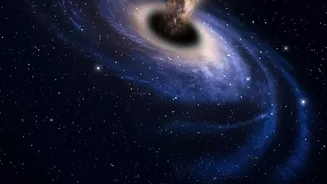
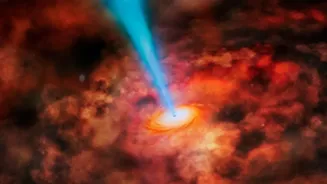
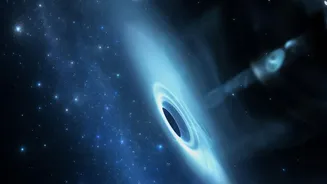
Instead of breaking cosmology, these little red dots (LRDs) may be an entirely new type of object previously only theorized. As more data came in, a compelling new explanation emerged that is gaining consensus: the LRDs are not galaxies full of stars, but are instead supermassive black holes at the center of a swirling, dense cocoon of gas and dust. This theoretical object, often called a 'black hole star' or 'quasi-star', is powered not by nuclear fusion like a normal star, but by the immense energy released as the central black hole ravenously consumes the surrounding gas. This process would create an object that is incredibly bright, compact, and red in appearance, perfectly matching the profile of the LRDs.
Cracking the Cosmic Case
The theory gained significant traction thanks to Webb’s powerful spectroscopic tools, which can analyze the chemical composition and dynamics of light from distant objects. A major breakthrough came from a detailed study of a specific LRD designated GLIMPSE-17775. By capturing the deepest spectrum of an LRD to date, astronomers found multiple lines of evidence pointing to the black hole star model. The light signatures did not match what would be expected from a collection of stars. Instead, they showed clear signs of a powerful ionizing source—the black hole—shrouded in a vast, dense cloud of gas, just as the theory predicted. This and other observations gave scientists the puzzle pieces they needed to fit the LRDs into our cosmic story without having to rewrite all the rules.
The Great Disappearing Act
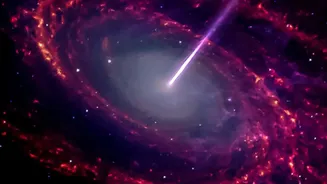
Another part of the mystery was why these LRDs seem to be abundant in the early universe but then vanish from view as the cosmos ages. It turns out they probably don't disappear at all—they evolve. The LRD phase is thought to be a temporary, but intense, period of growth for a supermassive black hole. Eventually, the black hole either consumes all the nearby gas or its incredible energy output blows the dusty cocoon away. Once this shroud is cleared, the object would no longer look like a little red dot. Instead, it would transform into a more familiar, unobscured active galactic nucleus (AGN) or quasar—the brilliantly bright cores of young galaxies that are powered by the very same black holes.
Rewriting the First Chapter
The discovery and evolving explanation of LRDs represent a monumental step forward in astronomy. Far from breaking the universe, they solve a long-standing problem: how did the supermassive black holes at the center of nearly every large galaxy, including our own, get so massive so quickly? The LRDs appear to be the missing link—the 'seed' stage where these cosmic monsters grew at an incredible rate, hidden from previous telescopes. They show us that the early universe hosted a unique environment that allowed black holes to bulk up rapidly before their host galaxies had fully formed around them. This flips the script on some older theories and provides a crucial new chapter in the story of cosmic evolution.