




A Messenger from a Distant Star
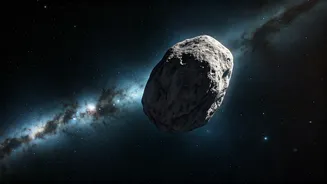
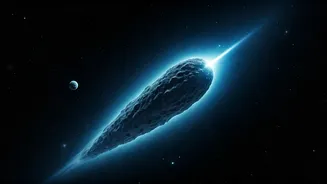
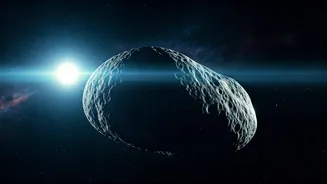
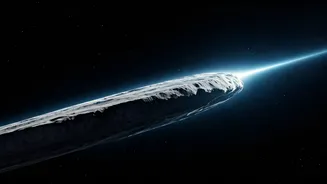
Objects from beyond our solar system, known as interstellar objects, are incredibly rare finds. To date, only a handful have ever been confirmed, including the enigmatic 'Oumuamua and the more comet-like 2I/Borisov and 3I/ATLAS. These visitors are not
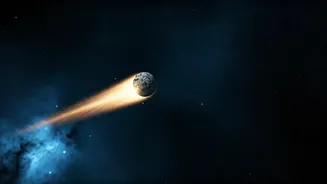
just curiosities; they are physical samples from the protoplanetary disks of other stars, essentially time capsules carrying the raw ingredients of their home systems. When one of these objects, typically a comet, ventures close enough to our Sun, it heats up and releases gas and dust from its surface. This cloud of material, called a coma, is a treasure trove of information, providing a direct glimpse into the chemical environment where it originally formed billions of years ago.
How to Read a Cosmic Barcode
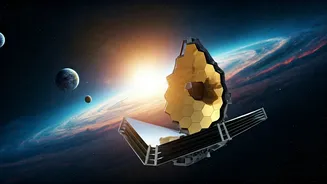
So, how do scientists read the secrets locked inside a comet from another star? The key technique is called spectroscopy. Every chemical element and molecule absorbs and emits light at specific, unique wavelengths, creating a pattern that acts like a 'barcode'. By capturing the light from the comet's coma with powerful telescopes, like the James Webb Space Telescope (JWST), and splitting it into its constituent colours, astronomers can identify these chemical fingerprints. This allows them to determine the exact composition of the gas and dust being shed by the visitor, revealing what it's made of with incredible precision. It’s a powerful method that lets us analyze material from a distant star system without ever leaving our own.
Clues to a Faraway Home
The chemical makeup of an interstellar comet tells a story about its origins. For example, analysis of the interstellar comet 2I/Borisov revealed an unusually high concentration of carbon monoxide compared to comets from our own solar system. This suggests that Borisov likely formed in an extremely cold region, far out in the planetary system of its parent star—a region perhaps colder and with a different chemical mix than where our own comets were born. More recently, studies of the visitor known as 3I/ATLAS have revealed high levels of carbon dioxide, methane, and even organic alcohols like methanol, further pointing to a formation environment chemically distinct from our own. These differences in the ratios of elements like water, carbon, and nitrogen act as crucial clues about the building blocks of planets in another corner of the galaxy.
Building a Picture of the Galaxy
Each interstellar visitor adds a new, vital data point to our understanding of planetary formation. By comparing the chemistry of these objects to our own solar system’s comets, scientists can start to answer fundamental questions. Are the chemical ingredients for planets—and perhaps life—the same everywhere? Or do different star systems have vastly different starting materials? The strange chemistries seen in objects like Borisov and ATLAS suggest a wide diversity across the galaxy. Some studies of 3I/ATLAS even suggest it may be incredibly ancient, perhaps forming 10 to 12 billion years ago, providing a chemical snapshot of the galaxy in its youth. These objects are essentially free samples delivered to our doorstep, allowing us to probe the conditions in distant star systems in a way that would otherwise be impossible.