






A World That Shouldn't Be Active
For decades, scientists assumed Pluto was a geologically dead world. At more than 3 billion miles from the sun, it receives too little heat to power the kind of geological activity we see on Earth. It was expected to be an ancient, crater-pocked ball
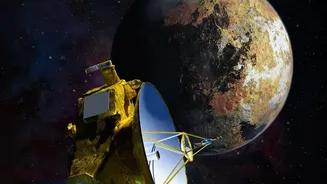
of ice. The flyby of the New Horizons spacecraft in 2015 shattered that assumption. Instead of a static, frozen relic, the probe revealed a dynamic and vibrant landscape, featuring vast plains, towering mountains, and signs of recent activity that have left scientists scrambling to explain how such a small, distant world could be so alive. The sheer complexity of its surface suggests Pluto has a roaring internal geologic engine, a finding that challenges our basic models of planetary evolution.
A 'Heart' of Flowing Nitrogen
The most iconic feature on Pluto is a massive, heart-shaped basin named Tombaugh Regio. The western lobe of this feature, Sputnik Planitia, is a colossal glacier composed not of water ice, but of frozen nitrogen, methane, and carbon monoxide. This isn't a static sheet of ice; it's a constantly churning system. The surface is covered in city-sized polygonal cells of ice that are convecting, or boiling, very slowly as faint heat from Pluto's interior escapes. This giant 'heart' acts as a climatic engine, with its ices sublimating into Pluto's thin atmosphere and then freezing back onto the surface elsewhere, driving weather patterns and feeding other glaciers that carve valleys into the landscape. Recent analysis suggests liquid nitrogen may even be seeping up from beneath the glacier, a shocking finding on a world with surface temperatures of -240 degrees Celsius.
Mountains of Water Ice and Icy Volcanoes
Surrounding the nitrogen plains are formidable mountain ranges, some reaching heights of over 3 kilometres. What makes them extraordinary is their composition: they are made of water ice. At Pluto's frigid temperatures, water ice is as hard as rock and forms the planet's bedrock. These immense blocks of water ice appear to float on the denser, softer nitrogen ice of Sputnik Planitia like giant icebergs. Even more startling is the evidence for cryovolcanoes, or ice volcanoes. Features like the massive Wright Mons are not thought to erupt molten rock, but a cold, slushy mixture of water, ammonia, or methane from beneath the surface. The discovery of these unique structures suggests Pluto has been geologically active far more recently than anyone predicted.
The Ultimate Surprise: A Hidden Ocean
Perhaps the most profound and challenging discovery is the mounting evidence that Pluto hides a vast ocean of liquid water beneath its frozen crust. Initially, the idea seemed impossible on such a cold world. But several lines of evidence, from large cracks and faults on the surface to models of how the Sputnik Planitia basin formed, point to a liquid layer. This ocean would be kept from freezing by a thick insulating shell of water ice and, potentially, residual heat from Pluto's formation. If a hot, rapid formation is what allowed Pluto to retain its heat, it implies that other large dwarf planets in the Kuiper Belt, like Eris and Makemake, could also harbour oceans, radically expanding the number of potentially habitable worlds in our solar system.