





The Administrative Heart: B.B.D. Bagh
Any architectural tour must begin at B.B.D. Bagh, formerly Dalhousie Square. This was the epicentre of British India's commercial and political power. The square is dominated by the imposing Writers' Building. Designed by Thomas Lyon in 1777, it was originally
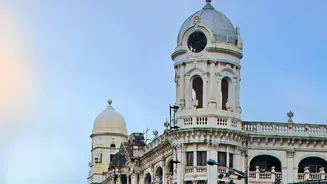
built to house the junior clerks or 'writers' of the British East India Company. This red-bricked behemoth, with its Greco-Roman facade and statues of Greco-Roman gods adorning its terrace, later became the seat of the Bengal government. The area was renamed B.B.D. Bagh in honour of three young freedom fighters—Benoy, Badal, and Dinesh—who stormed the building in 1930 and assassinated the Inspector General of Prisons. Nearby stands the stunning General Post Office (GPO), with its high-domed roof and Corinthian columns, and St. Andrew's Kirk, the city’s only Scottish church.
A Monument to an Empress: Victoria Memorial
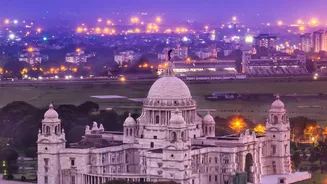
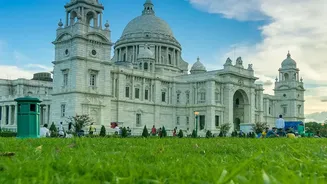
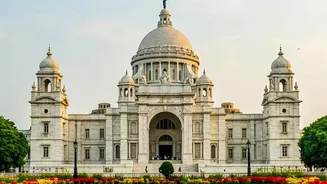
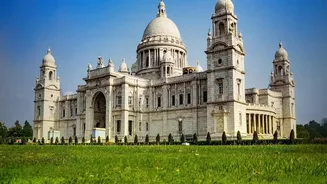
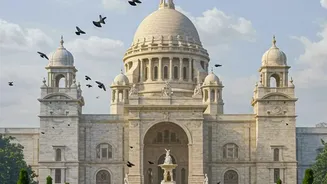
Perhaps no structure is more synonymous with colonial Kolkata than the Victoria Memorial. Conceived by Viceroy Lord Curzon after the death of Queen Victoria in 1901, this magnificent white marble monument was intended to be a tribute to her reign. Built between 1906 and 1921, its design blends European architectural styles with Mughal influences, leading many to draw comparisons with the Taj Mahal. The marble itself was sourced from Makrana in Rajasthan, the same quarry that supplied the stone for the Taj. Surrounded by 64 acres of lush gardens, the memorial is now a museum housing a vast collection of colonial-era artefacts, paintings, and sculptures. Crowning the central dome is a bronze 'Angel of Victory', which rotates on ball bearings when the wind is strong enough.
Sanctuaries of Faith and Power
A short distance from the Victoria Memorial lies St. Paul's Cathedral, a spectacular example of 'Indo-Gothic' architecture. Completed in 1847, it was the first Anglican cathedral built in the overseas territories of the British Empire. Its design was adapted for the Indian climate, featuring a tall spire, stained-glass windows, and a vast nave that can hold up to a thousand people. The original spire was destroyed in an earthquake in 1934 and was later rebuilt, modeled on the Bell Harry Tower of England's Canterbury Cathedral. Further cementing the area's judicial and administrative importance is the Calcutta High Court. Designed by Walter Granville, its impressive Neo-Gothic building was completed in 1872 and is modelled after the Cloth Hall in Ypres, Belgium.
Beyond the Grand Monuments
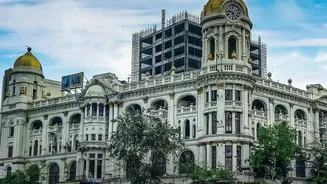
The city's colonial fabric extends beyond these well-known landmarks. The South Park Street Cemetery, established in 1767, is a hauntingly beautiful site filled with Gothic and Indo-Saracenic tombs and monuments. It offers a unique glimpse into the lives and deaths of the early European residents of the city. The Marble Palace, a 19th-century mansion built by Raja Rajendra Mullick, showcases a Neoclassical style and houses an extensive collection of art and antiques. Even former department stores like the Metropolitan Building, once the grandest shop this side of the Suez, tell a story of a city that was a global hub of commerce and fashion during the British Raj.