



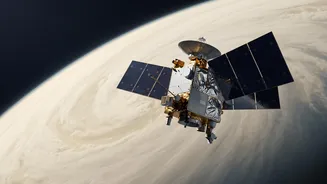
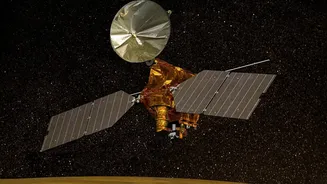
What is the Shukrayaan Mission?
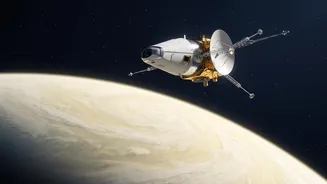
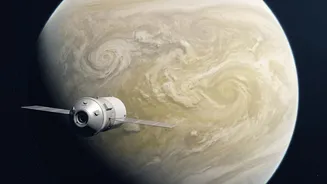
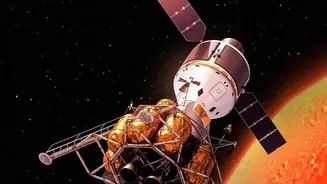
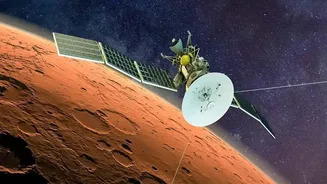
Shukrayaan is India’s first dedicated mission to Venus, an orbiter designed to conduct a comprehensive global survey of the planet. Following the historic successes of the Chandrayaan moon missions and the Mangalyaan Mars mission, Shukrayaan marks ISRO's
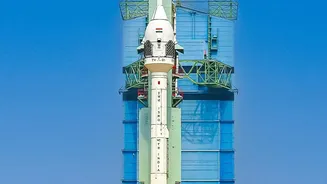
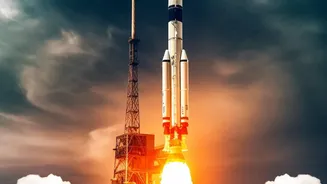
next major leap in interplanetary exploration. Formally approved by the Indian government on September 18, 2024, the mission is currently scheduled for a March 2028 launch aboard the powerful LVM-3 rocket. The spacecraft will embark on a 112-day journey before entering a highly elliptical orbit around Venus, which will be gradually adjusted for scientific observations.
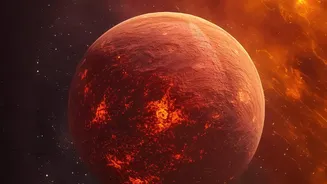
Venus: A World of Extremes
Understanding why Venus is such a compelling target requires appreciating its hostile environment. The planet is a cautionary tale of a runaway greenhouse effect, boasting a scorching surface temperature hot enough to melt lead, at over 460 degrees Celsius. Its atmosphere is incredibly dense, with a surface pressure about 90 times that of Earth's, and is composed almost entirely of carbon dioxide with thick, swirling clouds of sulfuric acid. But scientists believe Venus wasn't always this way and may have once been more like Earth, possibly with liquid water. Studying how it evolved into this scorching hothouse provides invaluable insights into climate change processes and the factors that define planetary habitability.
The Science Beneath the Clouds
A primary objective of Shukrayaan is to study the structure, composition, and dynamics of that thick, toxic atmosphere. The mission will carry a suite of instruments designed to peer below the opaque cloud tops and analyze the chemistry at play. One key area of interest is the potential for active volcanism, which could be a source of atmospheric gases. Another intriguing possibility stems from the 2020 detection of phosphine gas in the Venusian clouds—a chemical that, on Earth, is associated with anaerobic life. Shukrayaan will carry instruments, like the Franco-Russian VIRAL payload, capable of further investigating such potential biosignatures. This makes the study of Venus's cloud chemistry a critical part of the search for life elsewhere.
A Toolkit for an Alien World
To achieve its ambitious goals, Shukrayaan will carry a payload of around 19 scientific instruments from India and international partners, including Sweden, Russia, and Germany. The flagship instrument is a high-resolution Synthetic Aperture Radar (SAR), which can penetrate the dense clouds to map the planet's surface features with a resolution up to four times better than NASA's Magellan mission from the 1990s. Shukrayaan will also carry a world-first for Venus exploration: a ground-penetrating radar designed to study the planet's subsurface geology. Other instruments will analyze the interaction between the solar wind and the Venusian ionosphere, providing a holistic view of the planet as a complex system.
India's Expanding Interplanetary Footprint
The Shukrayaan mission solidifies India's position as a major force in global space exploration. By tackling the immense challenges of a Venus mission, ISRO demonstrates its growing capabilities in deep-space missions, from launch and navigation to sophisticated orbital maneuvers like aerobraking. The mission is part of a renewed global interest in Venus, with upcoming missions also planned by NASA and the European Space Agency. This collaborative international environment ensures that the data gathered by Shukrayaan will contribute significantly to a global understanding of how Earth-like planets form and evolve.