



The Cosmic Speed Limit
Everything in our universe is bound by a single, unbreakable rule: nothing can travel faster than the speed of light. In the vacuum of space, light zips along at a staggering 2,99,792 kilometres per second. It’s a speed so immense that it could circle
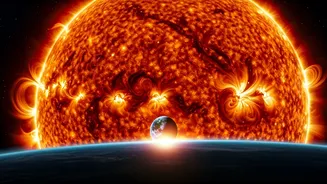
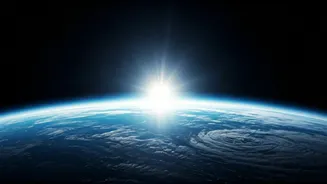
the Earth more than seven times in a single second. Yet, even at this incredible velocity, the journey from the sun to us is not instantaneous. Why? Because space is, for lack of a better word, enormous. The distance between our planet and its star is the crucial second part of the equation. This constant speed, known as 'c' in physics, is the ultimate speed limit of the cosmos, governing everything from our phone signals to the light from the most distant galaxies.
An Average Journey
The figure of eight minutes and twenty seconds is an average. Earth travels around the sun not in a perfect circle, but in a gentle oval called an ellipse. This means our distance from the sun changes throughout the year. At our closest point, called the perihelion (usually in early January), we are about 147.1 million kilometres away. At our farthest, the aphelion (in early July), we're about 152.1 million kilometres distant. The eight-minute, twenty-second travel time is based on the average distance, which is defined as one Astronomical Unit (AU), or about 149.6 million kilometres. So, when Earth is at its closest, sunlight takes about eight minutes and ten seconds to reach us. At its farthest, it’s closer to eight minutes and thirty seconds. The popular figure is a neat and tidy mean of this cosmic commute.
You Are Always Seeing the Past
Here is where the fact transforms from trivia into something profound. Because the light isn't instant, you are never seeing the sun as it is right now. You are always seeing it as it was eight minutes and twenty seconds ago. This creates a fascinating thought experiment: if the sun were to suddenly and magically vanish, we wouldn't know it for eight minutes and twenty seconds. For that duration, the sky would remain bright, Earth would continue to feel its warmth, and our planet would still follow its orbit as if nothing had happened. Then, suddenly, darkness would fall, and the gravitational tether holding us in orbit would snap. We live with a constant, unnoticeable time lag, receiving old news from our own star.
A Universal Time Machine
This eight-minute delay is just the first step on a much longer journey into the past. Every star you see in the night sky is a time capsule. The next closest star system, Alpha Centauri, is about 4.3 light-years away. The light we see from it tonight left that star 4.3 years ago. When you look at Polaris, the North Star, you are seeing 433-year-old light. The light you see from the beautiful Orion Nebula began its journey to your eyes around the time the Taj Mahal was being built. And it gets even more extreme. The Andromeda Galaxy, the most distant object visible to the naked eye, is 2.5 million light-years away. The faint, fuzzy patch of light we see is an image of that galaxy as it was 2.5 million years ago, long before modern humans walked the Earth. In this context, our eight-minute delay from the sun seems tiny, but the principle is the same: looking out into space is the same as looking back in time.
Why This Delay Matters
This cosmic lag is more than just a philosophical curiosity; it has practical implications for space exploration. When NASA engineers communicate with the Perseverance rover on Mars, the radio signals—which travel at the speed of light—can take anywhere from 5 to 20 minutes to travel one way, depending on the planets' alignment. This means a conversation with a rover involves a delay of 10 to 40 minutes. Engineers must program rovers to be autonomous and handle challenges on their own, because real-time control is impossible. Understanding this delay is fundamental to astronomy, cosmology, and our ability to explore the solar system. It forces us to build smarter, more independent technology and to accept that our view of the universe is always a historical record, never a live feed.