




A Second Life for a Historic Mission
Launched in 2006, NASA's New Horizons spacecraft was designed for a historic purpose: to conduct the first-ever close-up study of Pluto. It succeeded spectacularly in 2015, revealing the dwarf planet's heart-shaped glacier and complex, active surface.
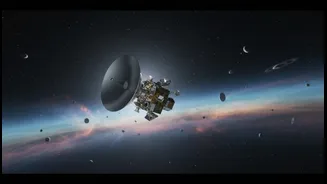
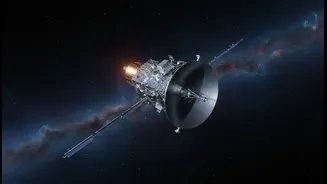
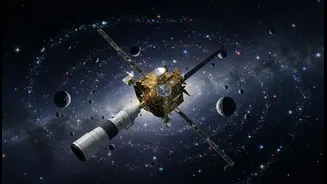
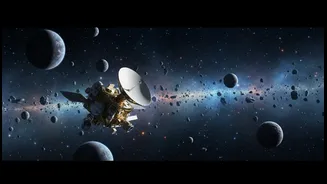
After that triumph, it continued deeper into the Kuiper Belt, a vast, icy debris field beyond Neptune. In 2019, it performed the most distant flyby in history, capturing images of a strange, snowman-shaped object named Arrokoth. But the mission's value didn't end there. Even as it speeds toward interstellar space, scientists have found a clever way to keep it doing groundbreaking science, transforming the entire spacecraft from a simple observer into a sophisticated measuring tool for mapping the cosmos.
The Power of Parallax
The key to this new method is a concept called parallax. It’s an effect you can see for yourself right now. Hold your thumb out at arm's length and close one eye, then the other. Your thumb will appear to jump back and forth against the distant background. This apparent shift is parallax. The distance between your eyes is the 'baseline'; the farther apart the two viewpoints, the larger the parallax shift for a nearby object. Scientists have long used Earth's orbit around the Sun as a baseline to measure the distance to nearby stars. Now, with New Horizons billions of kilometres away, they have an unprecedentedly long baseline. By taking a picture of an object from Earth and another simultaneously from New Horizons, the parallax effect is massive and easily measurable.
Using Trajectory as a Tool
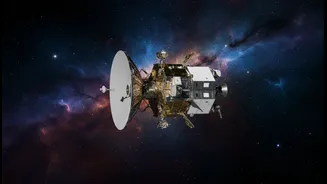
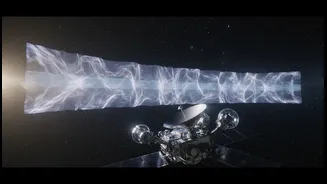
This is where trajectory analytics come in. To use the parallax method, scientists need to know the exact position of New Horizons at any given moment. This is achieved through the Deep Space Network, a system of large radio antennas that tracks the spacecraft by sending and receiving signals. By precisely timing how long these signals take, operators maintain an incredibly accurate model of the spacecraft's path, or trajectory. This known trajectory provides the location for one side of the parallax measurement. The spacecraft's motion itself becomes part of the experiment. Essentially, its journey isn't just taking it to new places; the journey is the instrument, providing the constantly changing vantage point needed to build a three-dimensional map of the outer solar system.
Mapping the Kuiper Belt
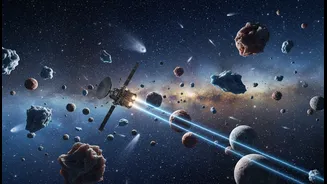
The Kuiper Belt was long theorized to be a vast disk of leftover material from the solar system's formation. It's composed of countless icy bodies, often called Kuiper Belt Objects (KBOs) or, more simply, comets. While we know many large KBOs exist, seeing the full distribution is difficult. The space between them is immense. By using New Horizons to measure the parallax of KBOs, scientists can determine their distances with much greater accuracy than by just using telescopes on Earth. This allows them to build up a more accurate census and identify areas where these primordial comets are more densely clustered. Understanding this distribution is crucial, as it holds clues about how planets like Neptune formed and migrated, shaping the architecture of our solar system.
The Future of Interstellar Navigation
This innovative use of New Horizons is more than just a clever trick; it’s a proof of concept for a new type of autonomous navigation. Future probes venturing into interstellar space won't always be able to rely on constant communication with Earth. The parallax technique, using a spacecraft's own camera to observe nearby stars and calculate its position, could allow for a form of interstellar GPS. By demonstrating this capability with New Horizons, the science team has not only unlocked new insights into our own solar system but has also paved the way for future generations of spacecraft to explore the galaxy with greater independence. It's a fitting legacy for a mission that continues to push the boundaries of exploration.