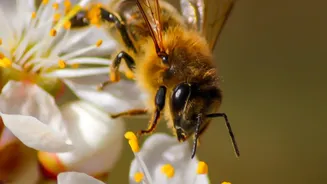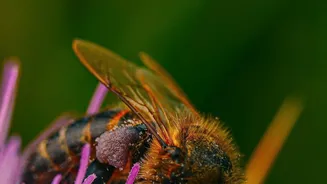





When a honeybee lands on a flower, it sees something we can’t. Beyond the vibrant colours visible to the human eye lies a secret world of patterns and signals, painted in a light we are biologically unable to perceive: ultraviolet.
A Different Kind of Vision
Human and honeybee vision
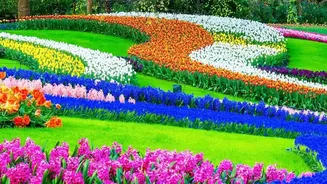
share a fundamental similarity: both are trichromatic. This means our eyes have three types of colour receptors (cones) that allow us to perceive the world. For humans, these receptors are tuned to red, green, and blue light. A honeybee’s eyes, however, are built differently. Their three photoreceptors are sensitive to green, blue, and ultraviolet (UV) light. This gives them access to a portion of the electromagnetic spectrum that is entirely hidden from us. While we see a red rose as a bold, striking colour, a bee, which lacks a red receptor, perceives it as a dark, uninteresting shape. Conversely, flowers we might consider plain can appear to a bee as a dazzling, high-contrast display. It’s a reminder that our perception of reality isn't the only one.
Flowers' Secret Landing Strips
So, what exactly are bees seeing with this superpower? Many flowers have evolved to have patterns on their petals that are only visible in ultraviolet light. These markings, often called 'nectar guides' or 'floral guides', act as signposts for foraging bees. To a bee, a seemingly uniform yellow flower might have a dark, UV-absorbing centre that creates a bullseye effect, pointing directly to the nectar and pollen reward within. Other flowers feature UV patterns that look like stripes or landing strips, all designed to make a bee’s job easier and more efficient. This reduces the time a bee has to spend searching for its food, which is a critical advantage when energy is limited. These patterns are the result of specific pigments in the petals that absorb UV light, creating a stark contrast with the parts of the flower that reflect it.
An Ancient, Silent Conversation
This unique visual ability is no accident; it's a stunning example of co-evolution. For over 100 million years, flowering plants and bees have been locked in a mutually beneficial relationship. Flowers need to be pollinated to reproduce, and bees need nectar and pollen for food. This shared need drove both to adapt. Flowers evolved features to attract the most efficient pollinators, developing not just bright colours and alluring scents, but also these secret UV invitations. Bees, in turn, evolved the sensory equipment to see these signals. The relationship is a masterclass in natural efficiency. Plants that provided clearer signals were more likely to be visited and pollinated, while bees that could spot these guides were better fed and more successful. This reciprocal adaptation has shaped the biodiversity we see today, from the structure of flowers to the very way a bee sees its world.
More Than Just Two Eyes
A bee's visual system is even more complex than its ability to see UV light suggests. In addition to their two large compound eyes, which are made of thousands of tiny lenses called ommatidia, bees have three smaller, simpler eyes on top of their heads called ocelli. The large compound eyes are responsible for detecting colour, patterns, and movement, piecing together a mosaic-like image of the world. The ocelli, on the other hand, don't form detailed images. Instead, they are highly sensitive to light intensity and help the bee with navigation and maintaining stability during flight, allowing it to sense the sun's position even on cloudy days. This five-eyed system gives a bee an incredibly wide field of vision and makes it exceptionally good at detecting motion—one reason they are so difficult to swat.