



The Return of the Spokes
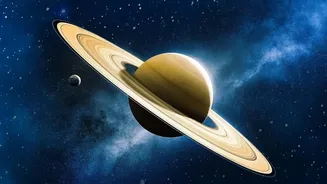
One of the most intriguing seasonal phenomena now being tracked by Hubble is the reappearance of mysterious features on the rings known as 'spokes'. These are transient, shadowy features that stretch across the rings, rotating along with them before disappearing.
First discovered by the Voyager 2 spacecraft in the 1980s, their appearance is tied to Saturn's seasons. They tend to vanish during Saturn's summer and winter solstices and reappear as the planet approaches its equinox. With Saturn's northern hemisphere autumnal equinox set for May 2025, 'spoke season' is officially upon us. Scientists believe these spokes are related to the planet's magnetic field interacting with the solar wind, creating an electrically charged environment similar to the aurora on Earth. Hubble's consistent monitoring provides a crucial opportunity to solve this long-standing mystery.
A Planet's Slow Turn to Autumn
Understanding Saturn's seasons requires a different sense of time. The gas giant takes over 29 Earth years to complete one orbit around the sun, meaning each of its four seasons lasts for more than seven years. Capturing these slow, subtle shifts is a monumental task, and one perfectly suited to the Hubble Space Telescope. Through its Outer Planet Atmospheres Legacy (OPAL) program, Hubble has been conducting a yearly check-up on our solar system's outer planets. This long-term project has allowed astronomers to watch as Saturn's northern hemisphere transitions from the height of its summer toward autumn. These observations, taken over multiple years, show subtle changes in the color and brightness of the planet's atmospheric bands and even shifts in its powerful wind speeds, painting a picture of a dynamic, evolving world.
Seeing in a New Light
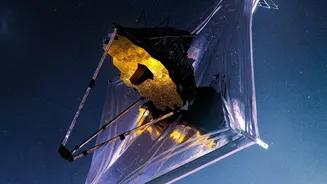
While the headline mentions infrared images, Hubble's primary strength in this context has been its sharp vision in visible and ultraviolet light over many years. However, its findings are now being combined with the powerful infrared capabilities of the James Webb Space Telescope (JWST) to create a more complete picture. Recent, complementary images from both telescopes released in March 2026 showcase this synergy. Where Hubble sees the familiar pale-yellow bands and detailed structures like the spokes, Webb's infrared view peers deeper. It can sense thermal emissions, revealing temperature variations and chemical compositions within the clouds and rings that are invisible to Hubble. This combination allows scientists to study Saturn's system in three dimensions, from its high-altitude hazes down to its deep cloud decks.
More Than Just a Pretty Ring
Beyond the visible seasonal changes, Hubble has helped uncover a more profound and surprising interaction: Saturn's rings are actively heating the planet's atmosphere. An analysis of four decades of data, calibrated by Hubble's precise instruments, revealed an excess of hot hydrogen in Saturn's upper atmosphere. The leading explanation is that a constant 'rain' of icy particles is falling from the rings onto the planet. This influx, possibly caused by micrometeorite impacts or interactions with the solar wind, creates a phenomenon never before seen in our solar system. This discovery fundamentally changes our understanding of the relationship between a gas giant and its ring system, showing that the rings are not just passive ornaments but active agents that influence the planet's very climate and composition.