


A Cosmic Collision Course
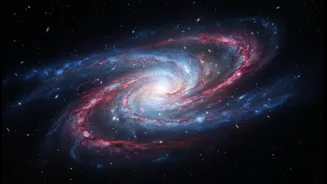
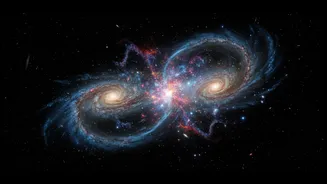
Galaxies are not static; they move, drift, and sometimes, they crash into each other. When two galaxies, especially gas-rich ones, are pulled together by gravity, they begin a long, intricate dance that can last hundreds of millions of years. Contrary
to what you might see in movies, individual stars rarely collide because the space between them is so vast. Instead, it's the immense clouds of interstellar gas and dust—the raw material for new stars—that bear the brunt of the impact. The gravitational forces of the merger violently disrupt the galaxies' structures, funnelling enormous quantities of gas toward the galactic center. This process can initially trigger a brilliant, frantic burst of star formation as the gas is compressed. But this is often the prelude to a much more dramatic event that brings the star-making party to an abrupt end.
Waking the Monster Within
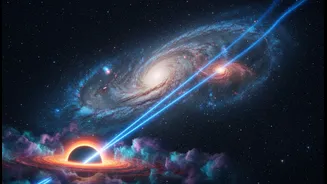
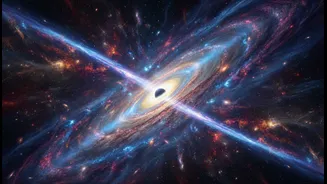
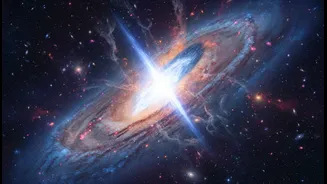
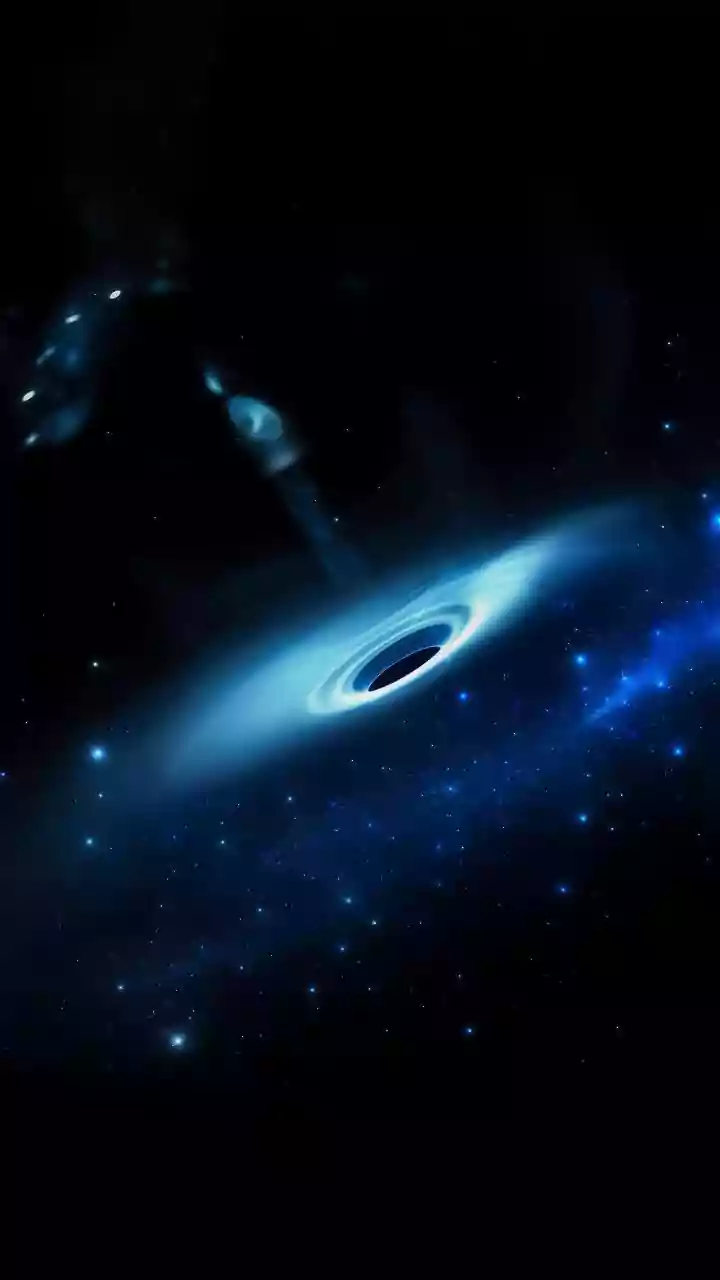
At the heart of most large galaxies, including our own Milky Way, lurks a supermassive black hole—a gravitational monster millions or even billions of times the mass of our sun. Most of the time, these behemoths are dormant, quietly sitting at the galactic core. However, a major galactic merger acts like a cosmic delivery service. The collision funnels huge amounts of gas and dust directly toward the central black hole, providing it with a massive feast. As the material swirls into the black hole, it forms a blazing hot accretion disk, unleashing a torrent of energy. This process transforms the dormant giant into an Active Galactic Nucleus (AGN), one of the most luminous objects in the universe.
The Great Galactic Blowout
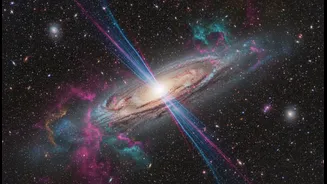
An activated supermassive black hole is not a neat eater. As it voraciously consumes the incoming gas, it launches powerful jets and winds of high-energy particles and radiation that blast outwards at nearly the speed of light. This phenomenon, known as AGN 'feedback,' acts like a powerful cosmic leaf blower. These outflows are so immensely powerful they can drive a massive 'blowout,' ejecting the galaxy's reservoir of cold gas. This is the essential fuel for forming new stars. Recent observations from the James Webb Space Telescope have confirmed this violent process, spotting the faint, disturbed remnants in galaxies that suddenly stopped forming stars billions of years ago.
Starvation and the 'Red and Dead'
Once a galaxy's supply of cold gas has been violently expelled into intergalactic space, it has been effectively sterilized. Without the raw materials to form new stellar nurseries, star birth grinds to a halt—a process astronomers call 'quenching'. The galaxy is left with only its older, longer-lived stars, which are typically redder in color. Over time, the galaxy transitions from a vibrant, blue, star-forming spiral into a so-called 'red and dead' elliptical galaxy, a quiescent system that will never create new stars again. These massive, quenched galaxies are common in the modern universe, and new research confirms that many of them have a violent merger in their past.