


A Sweet Find in the Void
Scientists have long suspected that the raw materials for life might have come from space, delivered to a young Earth by crashing meteorites. For years, they found amino acids (the components of proteins) and nucleobases (parts of DNA and RNA) in these
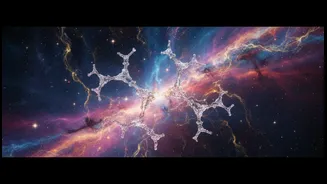
cosmic messengers. But a key ingredient remained missing: complex sugars. That has now changed. An international team of researchers announced the first definitive proof of ribose—a crucial component of RNA—in two separate meteorites. This wasn't just a trace finding; analysis showed concentrations of up to 180 parts per billion in the Murchison meteorite, a carbon-rich space rock that landed in Australia. The discovery provides the first solid evidence that biologically essential sugars can form in space and survive the fiery journey to a planet's surface.
More Than Just Sugar
Ribose is not just any sugar; it is the 'R' in RNA (ribonucleic acid). Before DNA became the primary blueprint for life, many scientists believe in the "RNA world" hypothesis, where RNA alone handled the jobs of storing genetic information and catalyzing the chemical reactions needed to sustain life. Finding ribose, but not the sugar for DNA (deoxyribose), in meteorite samples lends significant weight to this theory. It suggests that early Earth may have had a ready supply of extraterrestrial ribose, giving RNA a head start in the origin of life. This cosmic delivery system could explain how life managed to get started with such a fragile and complex molecule. As one NASA scientist noted, it’s remarkable that a molecule as delicate as ribose could be detected in such ancient material.
From Asteroids to Interstellar Clouds
The discoveries haven't stopped at meteorites. Pristine samples collected directly from asteroid Bennu by NASA's OSIRIS-REx mission have confirmed the presence of not only ribose but also glucose, a key energy source for life on Earth. This was a landmark finding, as the samples were untouched by Earth's environment, eliminating any chance of contamination. More recently, and even more profoundly, astronomers used radio telescopes to detect a four-carbon sugar called erythrulose in a gas cloud near the center of our galaxy. This pushes the origins of these life-giving molecules even further back, to the cold, diffuse interstellar medium from which stars and planets are born. It suggests that the chemical processes that create sugars are not unique to asteroids but are a universal feature of space chemistry.
The Intriguing Chemical Puzzle
While these discoveries are exciting, they also deepen the cosmic mystery. How do these complex molecules form in the harsh, cold vacuum of space? Laboratory experiments simulating interstellar conditions have shown that sugars like ribose and even deoxyribose can be created by blasting simple ices (made of water and methanol) with ultraviolet radiation. The detection of erythrulose in an interstellar cloud, however, complicates the picture, as its structure suggests it may form in ways chemists hadn't predicted for space. Furthermore, analyses of pristine asteroid samples from both Bennu and Ryugu have found all five of the nucleobases needed for DNA and RNA. This means nearly all the ingredients for the most fundamental processes of life—information storage (RNA/DNA), action (proteins from amino acids), and energy (glucose)—could be readily available throughout the solar system, waiting for the right conditions to come together.