






First, Find the Summer Triangle
Your quest begins with locating a giant, easily recognisable pattern in the night sky. The Summer Triangle isn’t a constellation itself, but an ‘asterism’—a prominent shape made of bright stars from different constellations. As dusk settles on a clear
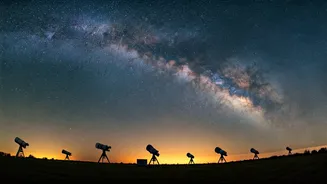
summer evening, look towards the eastern sky. You’ll see three brilliant stars that form a large, distinct triangle. Throughout the night, this triangle will appear to drift high overhead, making it a constant companion for stargazers in the Northern Hemisphere, from Delhi to Chennai. Its appearance is a sure sign that the best season for stargazing has begun.
Meet the Trio: Vega, Deneb, and Altair
The three stars that form the Summer Triangle are among the brightest in our night sky. The most brilliant of the three, and the one highest in the sky in early evening, is Vega. This dazzling blue-white star is the cornerstone of our search. The second star, to the lower left of Vega, is Deneb, which marks the tail of the swan constellation, Cygnus. The third star, forming the bottom point of the triangle and farther to the south, is Altair, the head of the eagle, Aquila. For our mission, Vega is the most important. It belongs to the small constellation of Lyra, the Harp, which is home to our target.
Zero In on the Constellation Lyra
Once you’ve identified Vega, you’ve found the constellation Lyra. While Vega is incredibly bright, the rest of Lyra is much fainter. Look closely near Vega and you should be able to spot a small, neat parallelogram of four dimmer stars. This little boxy shape represents the frame of the celestial harp. It’s a compact and charming constellation that’s easy to overlook, but it holds one of the sky’s true treasures. This parallelogram is your final signpost, guiding you to the exact location of the nebula. The two stars in the parallelogram furthest from Vega are your specific targets for the next step.
The Hunt for the Cosmic Smoke Ring
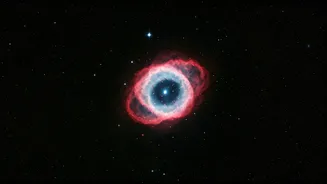
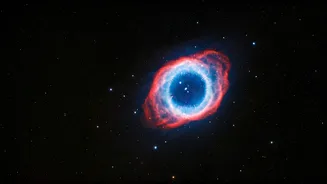
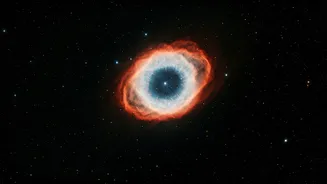
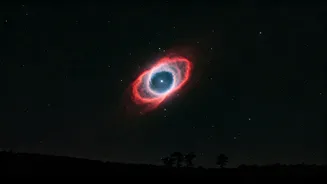
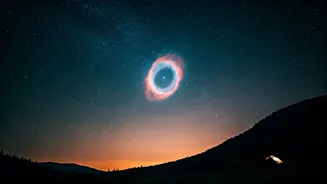
Now for the main event. The Ring Nebula, officially known as Messier 57 (M57), is located between the two stars at the bottom of Lyra’s parallelogram, Sulafat and Sheliak. It’s about halfway between them. To the naked eye, it's completely invisible. You will need some optical aid. With a good pair of binoculars, scan the area between those two stars. You might see a faint, fuzzy-looking 'star' that seems slightly out of focus. That’s it! If you have a small telescope (4-inch or larger), the view becomes spectacular. The fuzzy patch resolves into a tiny, ghostly donut or a celestial smoke ring floating in the blackness of space. It’s a challenging but incredibly rewarding object to find for the first time.
What Are You Actually Seeing?
When you spot the Ring Nebula, you are looking at the beautiful death of a star much like our own sun. It is a 'planetary nebula'—a name that is a bit misleading, as it has nothing to do with planets. About 2,300 years ago, the light from this event first reached Earth. The star, having run out of fuel, puffed off its outer layers of gas into space. This expanding shell of glowing gas is what we see as the ring. At its centre, though invisible in most amateur telescopes, is the star's incredibly hot and dense core, called a white dwarf. This remnant is now flooding the surrounding gas with ultraviolet radiation, causing it to glow in the ethereal way we see it.
Tips for the Best Celestial View
To give yourself the best chance of spotting the nebula, preparation is key. First, escape city lights. The darker your sky, the better your view will be. Even a short drive out of the city to a park or rural area can make a huge difference. Second, allow your eyes to 'dark adapt' for at least 20 minutes, avoiding looking at your bright phone screen. If you need a light, use a red torch, as red light is less damaging to your night vision. Finally, be patient. Deep-sky objects like M57 are faint. Take your time scanning the area, and don't be discouraged if you don't find it immediately. The thrill of the hunt is part of the fun.