
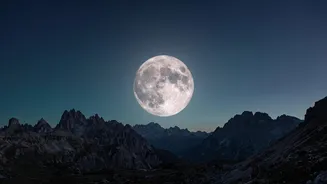
The Atmosphere as a Magnifying Glass
The popular theory goes something like this: when the moon is low in the sky, its light has to travel through a much thicker, denser slice of Earth’s atmosphere to reach your eyes. This dense air, the thinking goes, bends the light and acts like a cosmic
lens, magnifying the moon and making it appear larger than when it's high overhead in the thinner atmosphere. It sounds plausible, and for centuries, thinkers from Aristotle onwards have proposed some version of this atmospheric effect. It neatly explains the reddish color of a low moon, as the longer path through the air scatters away blue light. But when it comes to size, this theory falls apart under simple scrutiny.
A Lens That Actually Flattens
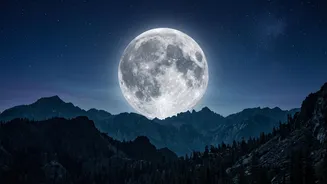
Atmospheric refraction does affect the moon's appearance, just not in the way most people think. Instead of magnifying it, the thicker air near the horizon actually squashes the moon slightly, making it look a bit oval or flattened. The light from the bottom edge of the moon travels through more air and is bent upwards more than the light from the top edge, causing this compression. The most definitive proof that the atmosphere isn't making the moon bigger is a simple photograph. If you take a picture of the giant-looking horizon moon and another of the small-looking zenith moon with the same camera settings, they will be the exact same size. In fact, the horizon moon is technically about 1.5% farther away from you, and therefore physically smaller in your field of view, than the moon at its highest point. The illusion is so powerful that it convinces us of a reality that photography proves is false.
It’s Not the Sky, It’s Your Brain
If it’s not a physical phenomenon, then what is it? The Moon Illusion is a psychological one. It’s a powerful trick of perception rooted in how our brains process visual information and judge distance. For thousands of years, this illusion has been a subject of debate precisely because the answer lies not in physics, but in the complex wiring of our own minds. The size we perceive an object to be isn't just about how big it is on our retinas; it's also about how far away our brain thinks it is. And this is where the horizon changes everything.
The Ponzo Illusion and Familiar Cues
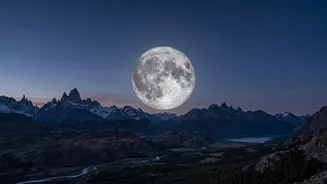
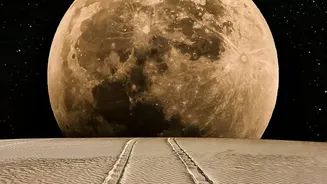
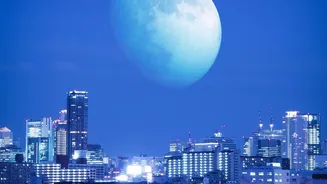
One of the most widely accepted explanations is a classic optical trick called the Ponzo Illusion. Imagine two identical lines drawn across a set of converging railroad tracks. The line drawn 'farther away' up the tracks will look bigger because your brain assumes that for it to appear the same retinal size as the 'closer' line, it must be physically larger. The horizon moon works the same way. When the moon is low, your brain sees it alongside trees, buildings, and mountains—objects on the ground that provide depth cues. Your brain knows these objects are far away, so it assumes the moon, appearing behind them, must be even farther and therefore colossal in size. When the moon is high overhead, it’s surrounded by empty space, with no reference points for scale, so your brain just sees it as a small object in a vast, empty expanse.
The Flattened Sky Dome
Another contributing theory is the 'apparent distance' hypothesis, which suggests we perceive the sky not as a perfect hemisphere, but as a flattened dome. We intuitively feel that the horizon is much farther away than the point directly above our heads. Think about clouds: clouds overhead might be just a few miles away, while clouds on the horizon could be a hundred miles distant. Our brain applies this same logic to the moon. When it’s on the distant-seeming horizon, our brain compensates for the perceived distance by making the moon look larger. When it's at the 'closer' zenith, our brain doesn't make this size adjustment. While scientists still debate the precise combination of factors, they agree on any fundamental truth:the Moon Illusion is a grand spectacle staged entirely inside your head.