




A New Look at a Familiar Neighbor
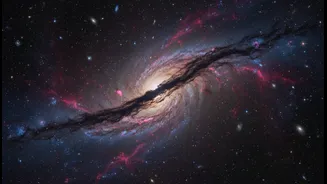
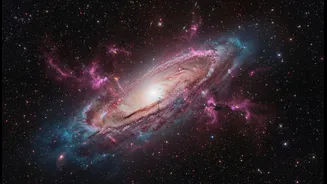
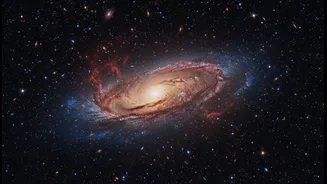
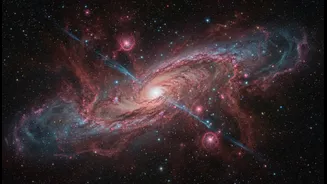
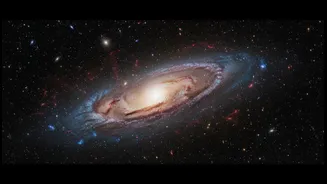
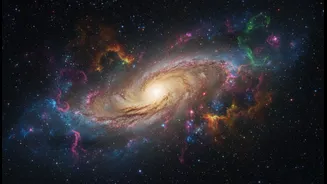
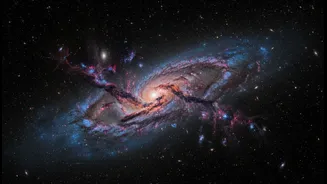
The subject of Webb’s latest portrait is Centaurus A, a galaxy located a relatively close 11 million light-years from Earth. It has long been a subject of fascination for astronomers because it is what’s known as a starburst galaxy, a place experiencing
an unusually high rate of star formation. Scientists have known for years that this hyperactivity is the result of a dramatic cosmic collision. About two billion years ago, a large elliptical galaxy is believed to have merged with a smaller spiral galaxy, an event whose aftermath is still visible today in Centaurus A's peculiar and distorted structure. Because of this, it serves as a perfect natural laboratory for understanding how such mergers shape galactic evolution.
Peering Through the Cosmic Dust
While Centaurus A is a familiar object, much of its core has remained hidden. Thick lanes of cosmic dust have historically blocked the view of telescopes that see in visible light, like the Hubble Space Telescope. Even previous infrared observatories, such as the now-retired Spitzer Space Telescope, could only make out large-scale structures without resolving finer details. This is where the James Webb Space Telescope (JWST) changes the game. Its powerful and highly sensitive infrared instruments can pierce through the obscuring dust, finally revealing the galaxy's heart in unprecedented clarity. What previously looked like dark, empty lanes are now revealed to be a densely packed tapestry of millions of individual stars.
Galactic Archaeology and a Violent Past
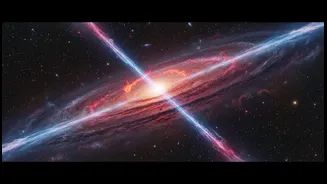
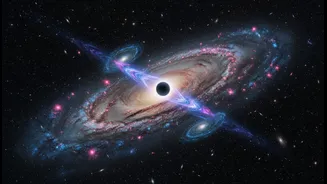
The new images from Webb’s MIRI (Mid-Infrared Instrument) and NIRCam (Near-Infrared Camera) are more than just pretty pictures; they are a historical record. By resolving individual stars, astronomers can now engage in a kind of 'galactic archaeology'. They can analyze different populations of stars to piece together a timeline of the galaxy's evolution—identifying which stars existed before the crash, which were born during the upheaval, and which formed from the gas stirred up in its aftermath. The images also provide a clearer view of the supermassive black hole at the galaxy's center, which is actively feeding on surrounding material and blasting out powerful jets of energy that further shape the galaxy around it.
The Dawn of New Questions
True to the nature of scientific discovery, Webb's clear view of Centaurus A has sparked as many questions as it has answered. The mid-infrared image highlights intricate and perplexing dust structures that astronomers had never seen before. These include a strange, warped, parallelogram-like band across the galaxy's center and a mysterious 'S' shaped feature that glows faintly. Scientists are not yet sure what created these shapes, but their origin may be linked to the ancient collision, the powerful influence of the black hole, or a combination of both. These unexpected features challenge existing models and open up entirely new lines of inquiry, demonstrating that even with our most powerful tools, the universe always holds new surprises.