

The Cosmic Data Bottleneck
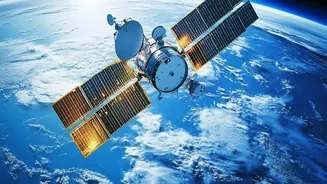
For decades, space missions have relied on radio waves to communicate with Earth. This method has been reliable, but it has a fundamental limitation: bandwidth. As our scientific instruments become more powerful, capturing incredibly detailed images and complex
data, radio frequency (RF) systems struggle to send that information back in a timely manner. A single high-resolution image from Mars, for instance, could take hours to transmit. For future human missions, which will require streaming high-definition video and constant data exchange, the RF bottleneck is a mission-critical problem that needs a next-generation solution.
A Breakthrough in Beams of Light
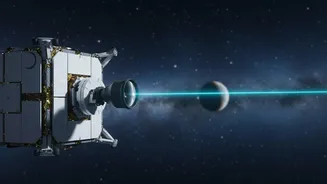
The solution is to use light itself. NASA's Deep Space Optical Communications (DSOC) experiment is demonstrating the power of laser communications. Instead of wide radio waves, DSOC uses a focused, near-infrared laser beam to carry information. Because near-infrared light packs data into much tighter waves, it can carry between 10 and 100 times more information than the most advanced radio systems used by missions today. Think of it as upgrading from a garden hose to a high-pressure fire hose—the amount of 'data' that can be pushed through is exponentially greater, enabling everything from high-resolution science imagery to live video feeds.
A Historic Deep Space Test
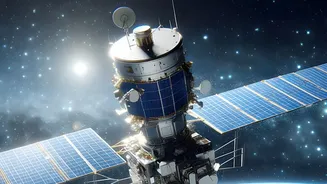
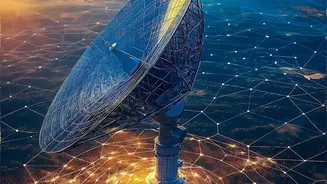
The DSOC system's capabilities were put to a stunning test. Riding aboard the Psyche spacecraft, the experiment successfully streamed an ultra-high-definition video from nearly 19 million miles away. The 15-second video, which humorously featured a cat named Taters chasing a laser pointer, was transmitted at a maximum speed of 267 megabits per second (Mbps). That's faster than many home broadband internet plans. The signal took 101 seconds to travel from the spacecraft to the Hale Telescope at Caltech's Palomar Observatory in California, where it was successfully downloaded. This achievement marked the first time ultra-HD video was streamed from deep space, proving the technology works over vast distances.
How the Laser Lock-On Works
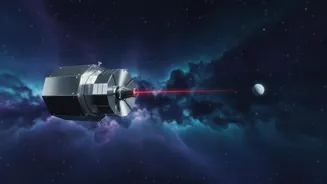
Transmitting a laser beam over millions of miles and hitting a target on Earth requires incredible precision. The process begins with a powerful uplink beacon laser from a facility on Earth, which is sent toward the spacecraft. The flight laser transceiver aboard the spacecraft then detects this beacon and locks onto it. This lock-on allows the transceiver to precisely aim its own downlink laser, which is encoded with data, back to the receiving telescope on Earth. The system is so precise it's like trying to hit a coin from a mile away. To counteract tiny vibrations from the spacecraft that could throw the beam off target, the DSOC hardware is mounted on a special stabilization system of struts and actuators, ensuring the laser stays perfectly pointed.
The Future of Interplanetary Internet
The success of DSOC is more than just a technical demonstration; it's the foundation for a new era of space exploration. This technology will be essential for supporting future human missions to Mars, allowing for high-definition video calls with astronauts and the rapid transfer of critical mission and health data. For robotic missions, it means scientists can get more data back, faster than ever before. Instruments that were once considered too data-intensive to be practical are now feasible. Future missions throughout the solar system will be able to send back a flood of information, transforming our ability to explore and understand the cosmos.