

The Origin: Eruptions on the Sun
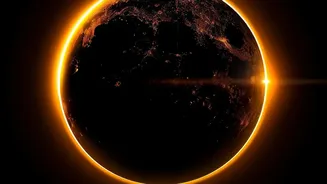
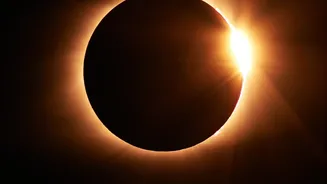
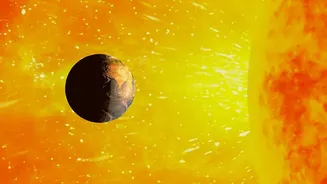
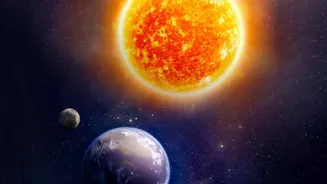
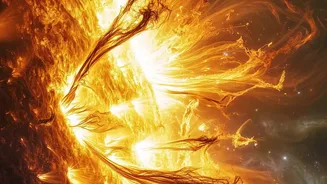
The journey of a solar storm begins 93 million miles away, on the turbulent surface of the Sun. The Sun's intense magnetic fields can get twisted and tangled like rubber bands. When these magnetic field lines suddenly snap and reconnect, a tremendous
amount of energy is released in what's known as a solar flare—an intense burst of radiation. Sometimes, these events are accompanied by something even more significant: a Coronal Mass Ejection, or CME. A CME is a massive eruption that hurls billions of tonnes of solar plasma—superheated, electrically charged gas—and magnetic fields out into space at speeds that can exceed millions of miles per hour. While a solar flare's radiation reaches Earth at the speed of light in about eight minutes, it’s the much slower but more massive CME that carries the bulk of a storm's power across the solar system.
The Journey: A Billion-Tonne Cannonball
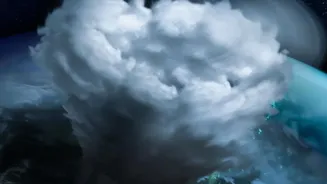
Once launched, the cloud of magnetised plasma from a CME travels across the vast emptiness of interplanetary space. Think of it as a billion-tonne cannonball hurtling through the solar system. This cloud of solar material expands as it travels, sometimes growing to be millions of miles wide. Its journey is not through a perfect vacuum; it plows through the ever-present solar wind, a constant stream of particles flowing from the Sun. The speed of the CME determines its travel time. The fastest storms can make the journey to Earth in as little as 15 to 18 hours, while slower ones might take several days. This travel time gives scientists on Earth a crucial window to observe the storm and predict its potential impact.
The Shield: Earth's Magnetic Defense
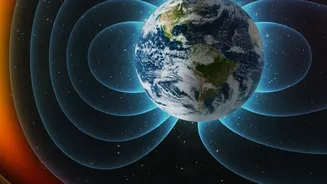
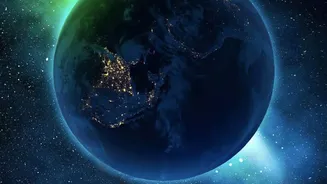
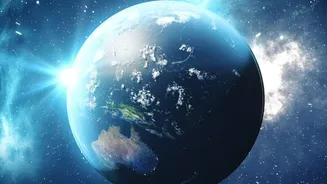
As the solar storm approaches its destination, it doesn't meet a defenceless planet. Earth is protected by a powerful, invisible force field called the magnetosphere. Generated by the molten iron in our planet’s core, the magnetosphere extends thousands of kilometres into space and acts as a shield, deflecting the majority of the solar wind and harmful radiation. When a CME arrives, it collides with this magnetic shield. The magnetosphere is compressed and deformed by the force of the impact, much like a bubble being squeezed. While it repels most of the storm's energy, it's not a perfect shield. Under a strong enough assault, the shield can buckle, allowing energy and particles to leak through, especially near the north and south poles where the magnetic field lines funnel inward.
The Impact: Auroras and Technological Risks
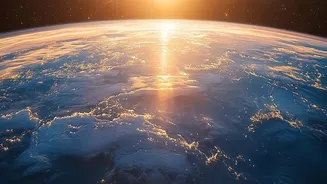
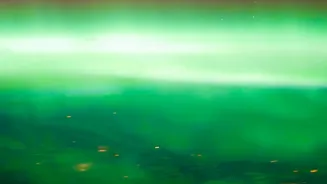
The collision between the solar storm and our magnetosphere is what creates 'space weather'. The most beautiful result is the aurora borealis (northern lights) and aurora australis (southern lights). When charged particles from the storm are funnelled down the magnetic field lines into our upper atmosphere, they collide with oxygen and nitrogen atoms, causing them to glow in mesmerising curtains of green, red, and purple light. However, this energy can also be disruptive. A severe geomagnetic storm can induce powerful electrical currents in power grids on the ground, potentially causing widespread blackouts. It can disrupt radio communications and GPS signals, affecting aviation and navigation. Satellites in orbit are particularly vulnerable, as the radiation can damage electronics and the storm can increase atmospheric drag, causing them to lose altitude.
Watching the Skies: How We Prepare
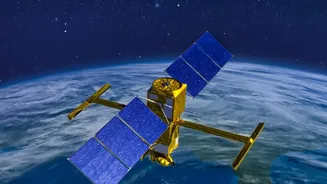
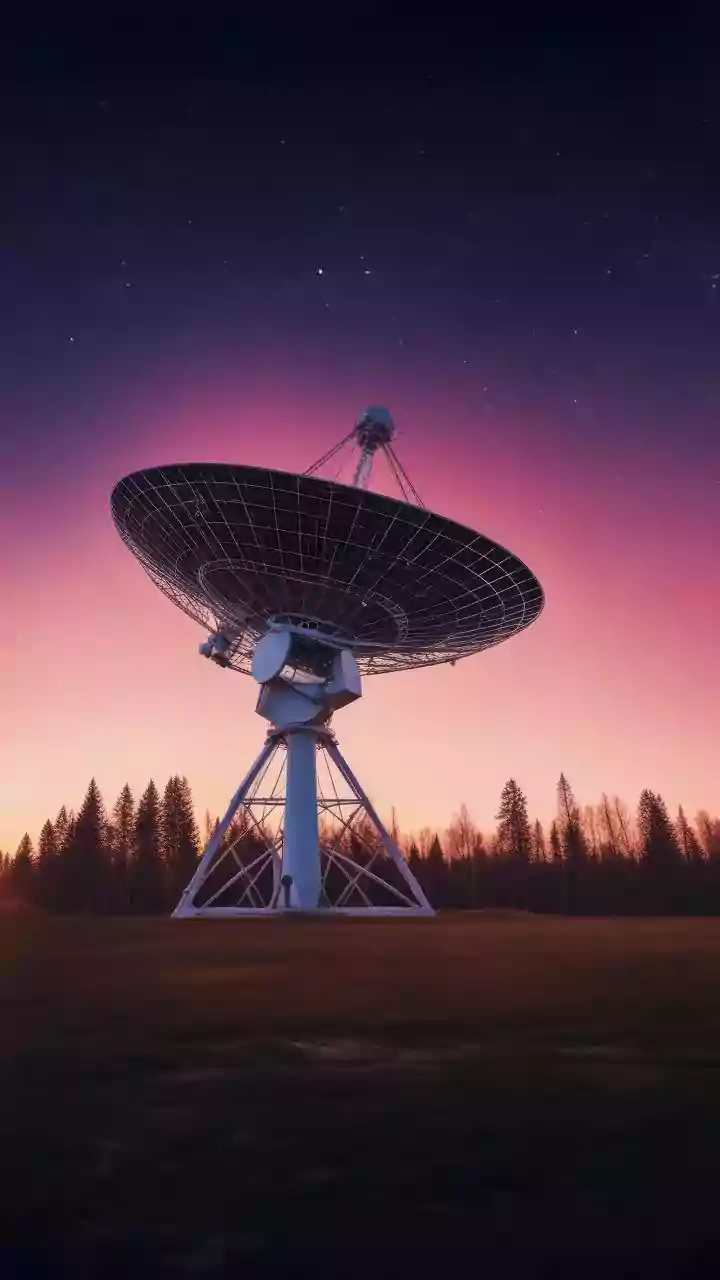
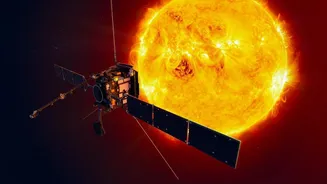
We are not caught completely off guard by these events. Agencies like NOAA's Space Weather Prediction Center (SWPC) and NASA constantly monitor the Sun. Using a fleet of satellites like the Solar and Heliospheric Observatory (SOHO), scientists can spot sunspots, solar flares, and CMEs as they happen. By observing a CME's size, speed, and direction, they can forecast its arrival time and potential severity. This provides crucial warnings to satellite operators, power grid managers, and airlines, giving them time to take protective measures, such as adjusting satellite orbits or preparing backup systems. As our world becomes ever more reliant on technology, understanding and predicting this cosmic weather is more important than ever.