


Meet S/2023 U1
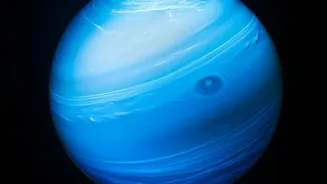
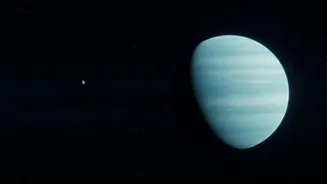
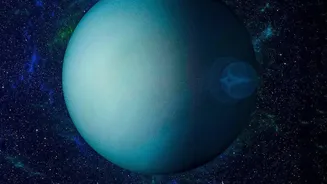
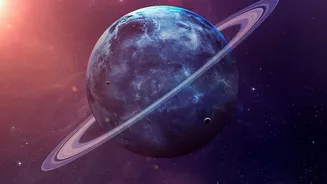
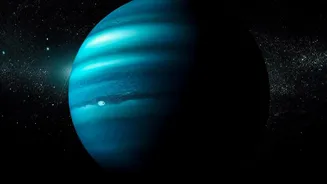
The newest addition to the Uranian system is provisionally named S/2023 U1. It’s a tiny world, estimated to be just eight kilometres in diameter, making it likely the smallest of Uranus's known companions. This faint moon was first spotted in November
2023 by astronomer Scott S. Sheppard using the powerful Magellan telescopes in Chile. Its discovery brings the planet’s official moon count to 28. Unlike the inner moons that circle Uranus in neat, planetary-plane orbits, S/2023 U1 is an 'irregular' moon. It follows a distant, eccentric, and long path, taking a lengthy 680 Earth days to complete a single orbit around its parent planet. Following tradition for the outer moons of Uranus, it will eventually be given a permanent name from a Shakespearean play.
How to Find a Cosmic Needle in a Haystack
Finding a moon this small and this far away is an immense technical challenge. Uranus is so distant that even large telescopes see it as just a small point of light. To find S/2023 U1, astronomers had to use a special technique. They took dozens of five-minute exposures over several hours and nights, with the telescope tracking Uranus as it moved against the background of distant stars. By digitally stacking these images, the faint light from background stars smears into long trails, while anything moving with the planet—like a tiny, undiscovered moon—appears as a single point of light. After spotting a potential candidate in November 2023, Sheppard conducted follow-up observations and was even able to find the faint dot in older images from 2021, which helped confirm its orbit and officially secure its status as a new moon.
A Window Into a Violent Past
The discovery of a moon like S/2023 U1 is more than just adding another name to a list; it’s about uncovering the history of the solar system. Its distant and inclined orbit strongly suggests it wasn't formed with Uranus but was instead a passing object captured by the planet’s immense gravity billions of years ago. Even more revealing is that its orbit is strikingly similar to two other irregular moons, Caliban and Stephano. This suggests they are part of a 'collisional family'. The leading theory is that a much larger parent moon was captured by Uranus long ago, only to be shattered by a collision with a passing comet or asteroid. The fragments, including S/2023 U1, Caliban, and Stephano, remain as evidence of this ancient, violent event, orbiting in a similar cluster.
The Hunt for More is On
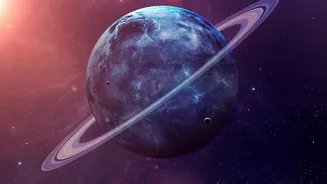
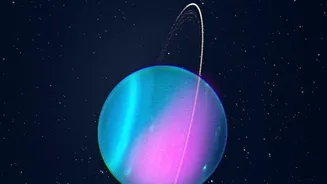
For decades, the ice giants Uranus and Neptune have been relatively neglected compared to their gas giant neighbours, Jupiter and Saturn. The last moon around Uranus was found over 20 years ago. But this new discovery signals a renewed focus on these mysterious outer worlds. Advanced ground-based telescopes made this find possible, but the game is changing again with the arrival of new technology. The James Webb Space Telescope (JWST), with its unparalleled infrared sensitivity, is now being used to survey the Uranian system, hunting for even smaller moons that may be lurking within its faint ring system. Scientists believe more undiscovered moons are likely, and finding them can help explain mysteries like the strange structure of the planet's rings. Each new discovery, no matter how small, helps paint a more complete picture of this lopsided planetary system.