



Beyond Supermassive
Astronomers are already familiar with supermassive black holes (SMBHs), which have masses millions or even billions of times that of our sun. One sits at the center of most large galaxies, including our own Milky Way, where Sagittarius A* weighs in at about
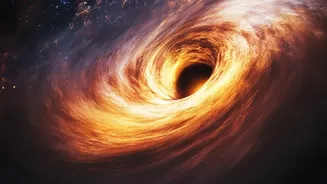
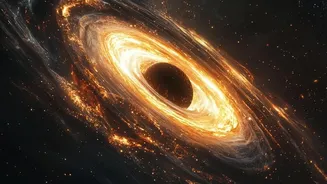
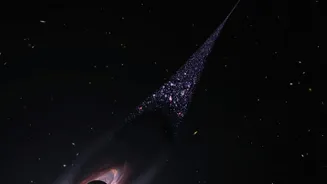
four million solar masses. The largest confirmed black holes, sometimes called 'ultramassive', can reach tens of billions of solar masses, with the current record holder, TON 618, estimated at around 66 billion. The new report, however, delves into a purely hypothetical class of objects nicknamed 'stupendously large black holes', or SLABs. These theoretical titans would start at 100 billion solar masses and could potentially grow much larger.
An Unconventional Origin Story
A black hole of such staggering size is unlikely to form through the conventional method of a star collapsing. Even the growth of SMBHs through consuming stars and gas or merging with other black holes has its limits. The process of accretion, where matter falls into a black hole, creates intense radiation that can push away other incoming material, effectively acting as a natural growth inhibitor. Instead, scientists propose that SLABs would have to be 'primordial'. This theory suggests they formed not from stars, but from the direct collapse of dense patches of matter in the chaotic, high-pressure environment of the very early universe, just moments after the Big Bang. This origin would allow them to bypass the size limits imposed by stellar evolution.
A Possible Answer to Dark Matter?
One of the most exciting implications of primordial black holes (PBHs) is their potential connection to dark matter. Dark matter is the mysterious, invisible substance that is believed to make up about 85% of the matter in the universe, holding galaxies together with its gravitational pull. Since PBHs are difficult to detect and would have formed before stars and galaxies, they are a compelling candidate for what dark matter could be. While recent studies suggest that SLABs themselves are too large and rare to account for all of the universe's dark matter, their existence would lend significant support to the broader theory of primordial black holes. If SLABs are real, it makes it more plausible that smaller, more numerous PBHs could indeed be the dark matter astronomers have been searching for.
The Challenge of Detection
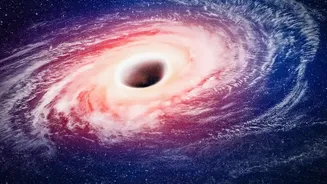
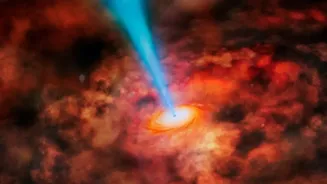
Finding a SLAB is a monumental challenge, primarily because they would be incredibly dark. Unlike the active supermassive black holes at the center of quasars, which are surrounded by bright, hot accretion disks of infalling matter, a SLAB floating in the cosmic void would not be actively 'feeding'. Without this tell-tale glow, they are effectively invisible. Detection would likely rely on indirect methods. One powerful technique is gravitational lensing, where a massive object bends the light from a star or galaxy behind it, creating a distorted or magnified image. Observing such an effect on a grand scale could reveal the presence of an otherwise hidden cosmic behemoth. Another theoretical possibility involves detecting their 'shadow' against the cosmic microwave background, the faint afterglow of the Big Bang.
Is There a Cosmic Size Limit?
While SLABs stretch our imagination, even they would have an ultimate size limit. Some models suggest that, given the age of the universe, there simply hasn't been enough time for a black hole to grow beyond a certain point, with theoretical maximums proposed around 270 billion solar masses. This is because the expansion of the universe eventually isolates black holes, cutting them off from the vast amounts of matter they would need to continue their stupendous growth. For now, these cosmic giants remain a fascinating theoretical possibility. No SLAB has ever been observed, and some theories of the early universe may not allow for their formation at all. They exist for now only in calculations, pushing the boundaries of what we think is possible.