



Beyond Rocket Science
For decades, the heroes of space exploration have been rockets and satellites. But as we prepare to send humans on longer journeys, the spotlight is turning to a quieter, more intricate science: bioastronautics. This field is the ultimate fusion of biology,
medicine, and engineering, focused on the study of life in space and the immense challenges the human body faces there. It answers the most critical question of all: how do you build a bubble of Earth in the hostile vacuum of space? Recognizing this need, the Indian Space Research Organisation (ISRO) and the Sree Chitra Tirunal Institute for Medical Sciences and Technology (SCTIMST) have launched India's first-ever Postdoctoral Fellowship in Bioastronautics, a landmark move to build domestic expertise for the Gaganyaan mission and beyond.
A Curriculum for Survival
This new two-year fellowship, which began in July 2026, is not a standard academic course. It is a highly specialized training ground for a new generation of Indian scientists. Fellows will split their time between SCTIMST's medical research facilities in Thiruvananthapuram and ISRO's Human Space Flight Centre (HSFC) in Bengaluru. The curriculum is designed to immerse them in the unique physiological and psychological stresses of space travel. They will study the deep-seated effects of microgravity on bone density and muscle mass, the dangers of cosmic radiation, the mental strain of isolation, and the complex ways the body's cardiovascular and immune systems adapt to an environment they were never meant to inhabit. The goal is to move beyond theory and foster the creation of practical biomedical technologies and solutions to keep astronauts safe and healthy.
Modeling a Habitable World
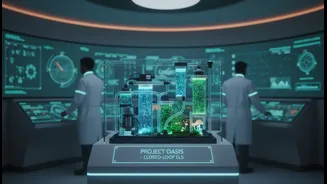
The direct output of this knowledge is the ability to design and model Environmental Control and Life Support Systems (ECLSS). An ECLSS is essentially a miniature, self-sustaining ecosystem designed for a spacecraft. It must flawlessly manage everything a human needs to live: providing clean air, recycling water from breath and urine, managing waste, and maintaining a stable temperature and humidity. Building these systems starts with modeling. Researchers use sophisticated software to create 'digital twins' of life support hardware, simulating how they will perform under the harsh conditions of a real mission. They test scenarios for equipment failure, calculate oxygen requirements down to the last gram, and model closed-loop systems where waste from one process becomes a resource for another. This new curriculum provides the foundational biological knowledge required to create these accurate models, ensuring that the systems being designed are based on a deep understanding of human needs in space.
Powering India's Cosmic Dream
The establishment of this bioastronautics program is a strategic masterstroke for India. Until now, the nation has often relied on international partners for the complex medical standards and technologies related to human spaceflight. By creating a pipeline of its own highly trained specialists, India is declaring its independence in one of the most critical sectors of space exploration. These researchers will become the architects of safety for the Gaganyaan crew and all future Indian astronauts. Their work is vital for extending mission durations, from a few days in Earth's orbit to potentially long-term stays on a future Indian space station or even missions to the Moon and beyond. It signals a major shift in focus from simply reaching space to creating a sustainable human presence there.