






A Long-Standing Cosmic Mystery
Saturn without its rings is almost unimaginable. Since Galileo first observed them as strange “handles” in 1610, they have captivated astronomers and stargazers alike. For a long time, scientists debated their origin. Were they formed along with Saturn 4.5
billion years ago, a primordial relic of the early solar system? Or were they a more recent addition? The answer remained elusive because we couldn't determine two crucial factors: the rings’ mass and their exact composition. Without knowing how much “stuff” was in them, it was impossible to calculate their age. It took a daring, one-of-a-kind mission to finally get the data needed to solve the puzzle.
The Clues from Cassini's Grand Finale
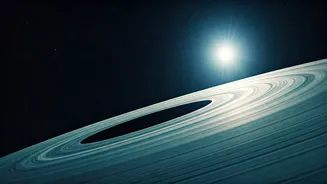
The game-changer was NASA's Cassini spacecraft. After studying Saturn for 13 years, the mission ended in 2017 with a spectacular series of 22 dives between the planet and its innermost rings. This “Grand Finale” was more than just a dramatic exit; it was a unique scientific opportunity. By flying through this previously unexplored gap, Cassini could feel the subtle gravitational pull of the rings, separate from the immense pull of Saturn itself. This allowed scientists to “weigh” the rings for the first time with incredible precision. The result was stunning: the rings were far less massive than most previous estimates had suggested. This single piece of data held the key to unlocking their age.
Why Less Mass Means Younger Rings
So, how does mass tell us the age? Think of it like a clean, white T-shirt. The longer you wear it, the more dust, dirt, and stains it accumulates. In space, the “dirt” comes from a constant shower of micrometeoroids and cosmic dust. If Saturn’s rings were ancient, having existed for billions of years, they would have been bombarded by this material for eons. This constant pollution would have made them much darker and, crucially, much more massive. But Cassini’s measurements showed the rings are surprisingly light and bright. They are about 99% pure water ice, with very little rocky contamination. This pristine condition is strong evidence that they haven't been around long enough to get dirty. Scientists now estimate their age to be between 10 million and 100 million years old—incredibly young in cosmic terms.
A Cosmic Crime Scene
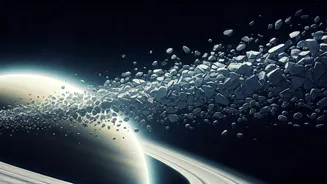
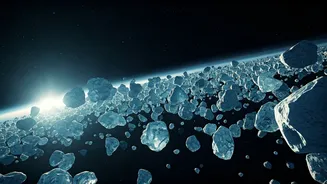
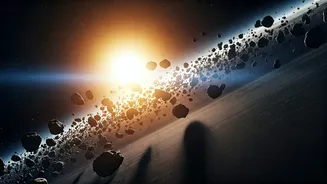
If the rings are young, they couldn't have formed with Saturn. So where did they come from? The leading theory is that they are the shattered remains of a celestial body that strayed too close to the gas giant. This could have been a large, icy moon or even a passing comet. Once it crossed a boundary known as the Roche limit, Saturn's immense gravitational forces would have torn it apart, shredding it into countless pieces of ice. These fragments then spread out into a thin, orbiting disk, forming the spectacular rings we see today. In this scenario, Saturn's rings are not a planetary feature but the beautiful debris field of a cosmic catastrophe that likely occurred when dinosaurs still roamed the Earth.
A Disappearing Act in Progress
The discovery of the rings' youth came with another shocking revelation: they are temporary. Data from Cassini and the Voyager probes confirmed that Saturn is actively destroying its own rings. A phenomenon dubbed “ring rain” is pulling the icy particles inward. Grained by solar radiation or tiny meteoroid impacts, the ice particles become electrically charged and are then funnelled down along Saturn's magnetic field lines, falling into the planet’s upper atmosphere. The rate of this loss is staggering. Scientists estimate the rings are losing material equivalent to a large swimming pool every half hour. At this rate, the entire ring system could be gone in as little as 100 million years—a mere blink of an eye in the life of the solar system.