




Cosmic Fingerprints in Starlight
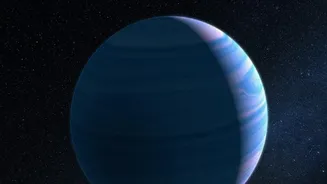
Imagine a planet hundreds of light-years away passing in front of its star. As the starlight shines through the planet's atmosphere, a tiny fraction of that light gets absorbed by the gases present. This is the core of a technique called transmission
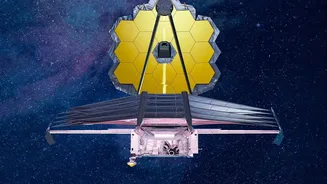
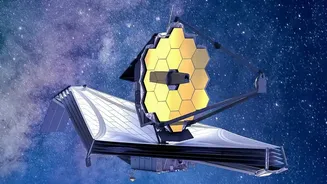
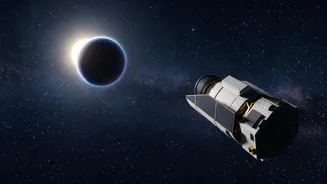
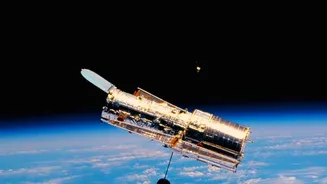
spectroscopy. Every gas—be it water vapour, carbon dioxide, or methane—absorbs light at a unique set of wavelengths, creating a chemical 'fingerprint'. Powerful observatories like the James Webb Space Telescope (JWST) can read these fingerprints. By measuring which colours of light are missing from the star's spectrum after it passes through the atmosphere, scientists can determine precisely what gases are floating in the air of that distant world. This has led to groundbreaking discoveries, including the first definitive detection of carbon dioxide in an exoplanet's atmosphere on a gas giant named WASP-39 b.
The Key to a Planet's Thermostat
Greenhouse gases are crucial for regulating a planet's temperature. On Earth, they trap heat and keep our world from freezing over. The same physics applies across the galaxy. When scientists detect carbon dioxide (CO2) and methane, they get a direct clue about the planet's potential climate. These gases are key indicators of a greenhouse effect. On the exoplanet K2-18 b, for instance, JWST detected both methane and carbon dioxide in a hydrogen-rich atmosphere. This discovery supports the hypothesis that the planet could be a 'Hycean' world—a hot planet with a water ocean beneath its atmosphere—making it a compelling target in the search for habitable environments. The presence and abundance of these gases allow researchers to start building models of a planet's climate, estimating its surface temperature and whether it might host liquid water.
Building a Climate Model from Light-Years Away
Finding a single gas is just the first step. The real magic happens when scientists combine all the available data. By looking at the ratios of different molecules—like how much methane there is compared to carbon dioxide—they can infer more complex processes. For example, the detection of sulfur dioxide on the planet WASP-39 b provided the first evidence of active photochemistry—chemical reactions triggered by starlight—on an exoplanet. This is similar to how Earth's ozone layer is formed and sustained. By feeding these chemical inventories into powerful computer models, scientists can simulate the exoplanet's entire climate system. They can explore whether the planet has clouds, strong winds, or extreme temperature differences between its day and night sides. This turns a simple point of light into a complex, dynamic world.
A Mirror for Understanding Earth
Studying exoplanet climates isn't just an abstract astronomical exercise; it provides a vital context for understanding our own planet. Exoplanets offer a glimpse into a variety of climate systems under extreme conditions that don't exist in our solar system. We see worlds with runaway greenhouse effects, planets tidally locked to their stars, and others that might be covered in global oceans. By testing climate models against these real-world examples, scientists can refine the very tools they use to predict Earth's future climate. These distant worlds act as natural laboratories, helping us understand planetary tipping points and how a world can transition from habitable to uninhabitable. This cosmic perspective helps clarify what makes Earth so unique and what it takes to sustain a life-bearing climate.