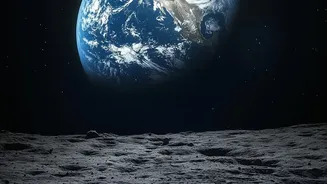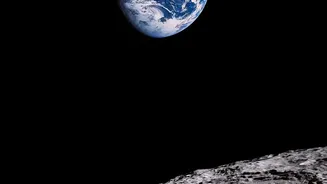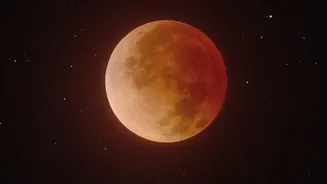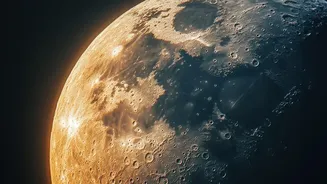





The idea of a 'dark side of the moon' is cemented in our culture, but it's a cosmic misunderstanding. The side we never see isn't always dark; in fact, it gets just as much sun as the side facing us. The real story is far more fascinating.
The Great Cosmic Stare-Down
The main reason
we only ever see one face of the Moon is a phenomenon called tidal locking. Billions of years ago, the Earth's immense gravity exerted a pull on the Moon, slowing its rotation. Over millions of years, this gravitational friction acted like a brake until the Moon's rotation period perfectly matched its orbital period. It now takes the Moon the same amount of time to spin once on its axis as it does to complete one orbit around the Earth — roughly 27.3 days. This synchronous rotation means the same hemisphere is perpetually turned toward us, giving us the familiar 'Man in the Moon' face, while the other side remains hidden from our direct view. It’s not that the Moon doesn't rotate; it rotates just once per orbit, keeping the far side perpetually out of sight from Earth.
Let There Be Light
So, if we can't see the far side, it must be dark, right? This is the core of the myth. The term 'dark side' is misleading; a more accurate term is 'far side'. In reality, both the near and far sides of the Moon experience a regular day-and-night cycle. A full lunar day — from one sunrise to the next — lasts about 29.5 Earth days. This means any given spot on the Moon, whether on the near side or far side, experiences approximately two weeks of continuous, harsh sunlight followed by two weeks of frigid darkness. As the Moon orbits the Earth, the Sun illuminates it from different angles. When we see a New Moon (which is dark to us), the far side is fully lit by the Sun. Conversely, during a Full Moon, the far side is experiencing its 'lunar midnight'.
A Tale of Two Hemispheres
When humanity finally got its first glimpse of the far side thanks to the Soviet Luna 3 probe in 1959, scientists were stunned. The two sides looked remarkably different. The near side, the one we are familiar with, is characterised by large, dark plains called 'maria' or seas. These are ancient, hardened lava flows that filled vast impact basins, giving the 'Man in the Moon' its distinct features. The far side has very few of these maria. Instead, it is almost entirely covered in a rugged, heavily-cratered landscape, including one of the largest craters in the entire solar system, the South Pole-Aitken basin. The crust on the far side is also thought to be significantly thicker, which may have prevented lava from flowing to the surface as it did on the near side.
The Origin of a 'Dark' Myth
If the far side gets plenty of sun, where did the term 'dark side' come from? The phrase predates space exploration by centuries. In this context, 'dark' wasn't meant as an absence of light, but rather as 'unknown' or 'hidden'. For most of human history, that half of the Moon was a complete mystery, so the term 'dark side' was used to describe its unknowable nature. This more poetic meaning became confused with literal darkness, a mix-up that was later solidified in popular culture, most famously by Pink Floyd's 1973 album, which used the phrase as a metaphor for the unexplored parts of the human psyche.