



When Galaxies Collide
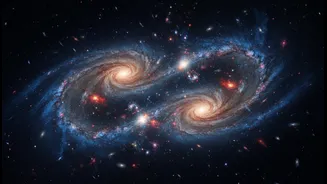
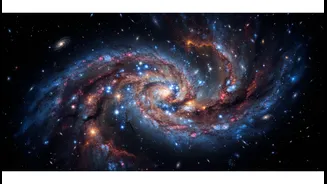
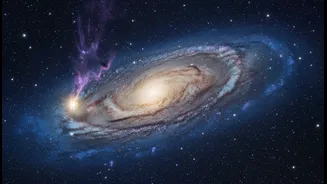
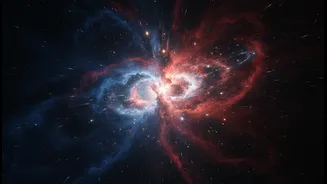
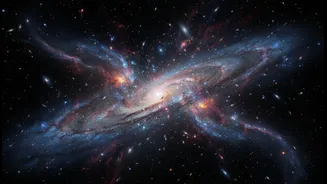
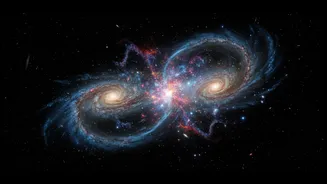
Imagine two sprawling cities made of stars, gas, and dust, each hundreds of thousands of light-years across, drawn together by gravity. This is a galaxy merger. As they approach, their mutual gravitational pull distorts their shapes, flinging vast streamers
of stars into space. Surprisingly, individual stars rarely collide because the space between them is immense. The real action happens with the galaxies' most vital ingredient: their enormous clouds of interstellar gas and dust. These are the raw materials for creating new stars, and the merger sets the stage for a dramatic transformation.
Funneling Fuel to the Core
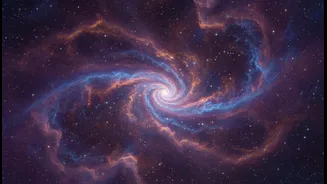
The heart of the process is something astronomers call gas inflow mechanics. As the galaxies dance closer, their gravitational forces act like a giant cosmic blender. These tidal forces disrupt the stable orbits of gas clouds, causing them to lose momentum and spiral inward toward the new, combined galactic center. Think of it as water swirling down a drain, but on a galactic scale. Vast quantities of hydrogen gas, once spread thinly across tens of thousands of light-years, are now being funneled into a surprisingly compact central region, creating an incredibly dense reservoir of star-forming fuel.
Igniting the Stellar Nursery
This massive concentration of gas is a stellar nursery on overdrive. Under normal conditions, a galaxy like our Milky Way might form a few new stars per year. But in the compressed core of a merger, the conditions are extreme. The gas becomes so dense that gravity takes over, triggering a runaway collapse of countless gas clouds simultaneously. This ignites a furious, galaxy-wide baby boom of stars known as a "starburst." In this phase, the galaxy can form hundreds or even thousands of times more stars than usual. This isn't a gentle process; it's a frantic, galaxy-shaping event.
The Dazzling Hyper-Luminous Result
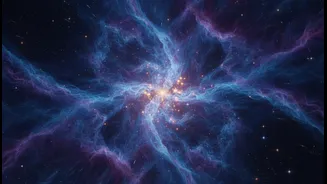
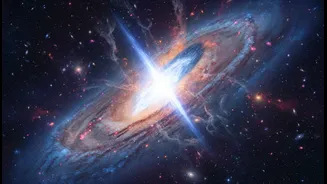
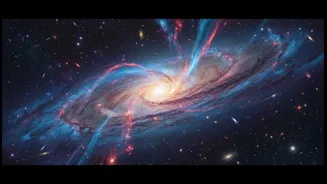
The result of this frantic star formation is a "hyper-luminous starburst core zone." These zones are among the most radiant objects in the universe. The luminosity comes from the thousands of massive, hot, blue stars that form in the starburst. However, these regions are so thick with the remaining gas and dust that most of this brilliant visible light is trapped and absorbed. The dust heats up and re-radiates this immense energy at infrared wavelengths. This is why these galaxies are often called Luminous Infrared Galaxies (LIRGs) or, in the most extreme cases, Hyper-Luminous Infrared Galaxies (HyLIRGs), shining with the power of trillions of suns.
A Furious and Fleeting Blaze
A hyper-luminous starburst is a brilliant but ultimately fleeting phase in a galaxy's life. The rate of star formation is so intense that the huge reservoir of gas is used up in a cosmic blink—perhaps only a few hundred million years, which is brief compared to a galaxy's lifespan of billions of years. The massive stars that power the glow also live fast and die young, exploding as supernovae that further shape the galaxy's evolution. After the starburst subsides, the merged galaxy settles down, often transformed into a large elliptical galaxy with few young stars, its wild, creative youth just a memory written in the cosmos.