




The Ground Beneath Our Feet
Across the country, a quiet revolution is taking place, revealing that the past is much closer than we think. From a farmer ploughing a field to a construction crew digging a foundation, everyday activities are unearthing extraordinary links to our ancestors.
These chance discoveries are transforming seemingly ordinary landscapes into rich historical archives, offering a tangible connection to the people who walked this land thousands of years ago. Each piece of pottery, every ancient coin, and all discovered ruins act as a new page in India’s ever-unfolding story, often found where we least expect it.
A Lost City in a Coconut Grove
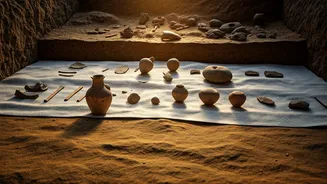
Perhaps no discovery illustrates this better than the Keezhadi excavation in Tamil Nadu. What began in 2015 as a survey in a coconut grove near Madurai has since unearthed a sprawling, sophisticated urban settlement from the Sangam Age. The findings have been nothing short of revolutionary, pushing back the timeline of literate, urban civilisation in Tamil Nadu to at least 800 BCE. Archaeologists have uncovered over 18,000 artefacts, including well-laid brick structures, drainage systems, and a wealth of objects that paint a vivid picture of daily life. There are exquisite potsherds with Tamil-Brahmi inscriptions, indicating a highly literate society, alongside glass beads, shell bangles, ivory dice, and tools for weaving. These weren't just relics; they were the possessions of a thriving society with advanced industries and robust trade networks, all hidden for centuries beneath an unassuming patch of land.
The Farmer's Fortuitous Find
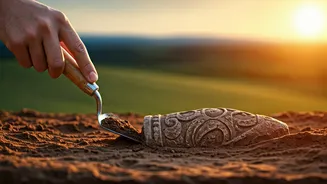
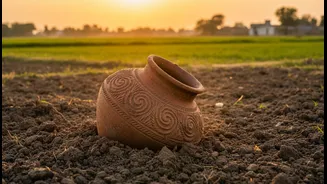
The story of Keezhadi is remarkable, but it's part of a much larger pattern of discovery driven by ordinary people. In 2020, a farmer ploughing his field in Telangana unearthed a magnificent statue of a Jain Tirthankara dating back to the 9th century. This single find prompted archaeologists to investigate further, revealing evidence of a long-lost temple buried in the same area. Similarly, another farmer digging a fish pond near Agra stumbled upon the relics of an 11th-century Pratihara-era temple. And in Goa, a man clearing weeds on his cashew plantation found an earthen pot filled with over 800 copper coins from the 17th-century Portuguese era, offering fresh insights into the region’s economic past. These moments of serendipity highlight how our agricultural heartlands are also vast, unexplored archaeological landscapes.
More Than Just Objects
The significance of these discoveries goes far beyond the objects themselves. An ancient bead isn't just an ornament; it tells a story of trade routes and craftsmanship. The remnants of a megalithic burial urn found during a rainwater harvesting project in Kerala offer a glimpse into the spiritual beliefs and burial rituals of people who lived over 2,500 years ago. The discovery of thousands of archaeological specimens across 45 villages in Aurangabad revealed the existence of continuous rural settlements from the Satvahana dynasty onwards in an area previously thought to be empty of such history. Each artefact is a puzzle piece that helps historians and archaeologists reconstruct ancient lifestyles, diets, technologies, and social structures. They provide a direct, physical link to our heritage, grounding abstract historical narratives in real, tangible evidence.
A Nation of Citizen Guardians
What these finds also reveal is the crucial role of the public in preserving our national heritage. In almost every case of a chance discovery, it was the quick thinking and responsible action of an ordinary citizen that brought the find to the attention of authorities like the Archaeological Survey of India (ASI). By alerting experts, they ensure that these invaluable time capsules are protected and studied properly, rather than being lost to damage or the illicit antiquities trade. This partnership between the public and archaeologists is creating a dynamic, crowdsourced map of our history. It’s a powerful reminder that every citizen can be a guardian of the past, and that the next great discovery could be lying just below the surface, waiting for a curious eye.