



The Bizarre Timetable of Venus
On Earth, our daily and yearly cycles are comforting and predictable. A day is 24 hours, and a year is 365 days. We instinctively understand that a year is a much longer period than a day. But on Venus, this fundamental logic is turned completely upside
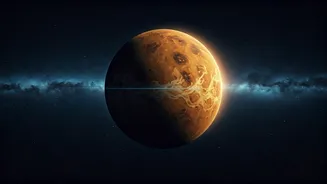
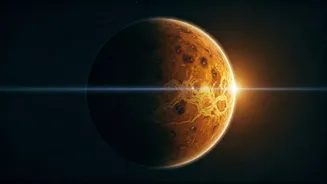
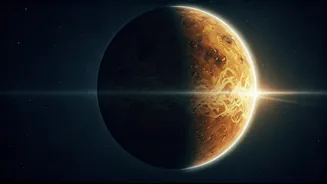
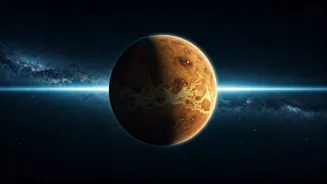
down. A single Venusian day—the time it takes for the planet to complete one full rotation on its axis—lasts for an astonishing 243 Earth days. In contrast, its journey around the Sun, which defines its year, takes only about 225 Earth days. This means that on Venus, a day is longer than a year. It's a concept so alien to our experience that it sounds like a riddle, but it's a simple, strange truth about our closest planetary neighbour. This incredible time-warp is the first clue that Venus is a world of profound extremes.
Why the Slow, Backward Spin?
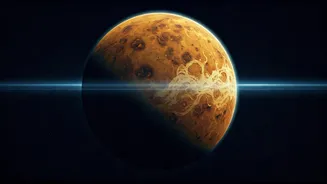
So, what causes this planetary peculiarity? The answer lies in Venus's rotation. Not only is it incredibly slow, but it's also retrograde, meaning Venus spins clockwise on its axis, while most other planets in our solar system, including Earth, spin counter-clockwise. Scientists have two leading theories for this behaviour. The first suggests that billions of years ago, a massive asteroid or other celestial body collided with Venus, catastrophically altering its spin and effectively knocking it 'backwards'. The second theory points to Venus's incredibly thick and heavy atmosphere. This dense blanket of carbon dioxide, about 90 times thicker than Earth's, may have created powerful atmospheric tides. Over millions of years, the gravitational pull of the Sun on this thick atmosphere could have acted like a brake, slowing the planet's rotation to its current crawl and eventually flipping its orientation. The truth may be a combination of both factors.
Living on Venus Time
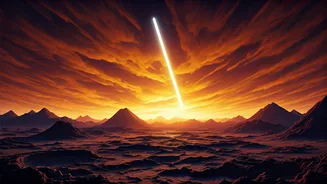
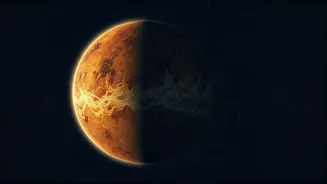
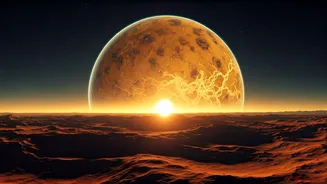
Let's imagine, for a moment, what it would be like to experience this. If you were standing on the surface of Venus (an impossible feat, given the crushing pressure and searing 465°C heat), the Sun would rise in the west and set in the east. But you would have to wait a very, very long time. The period from one sunrise to the next, known as a solar day, is about 117 Earth days. This means you would experience nearly two months of continuous daylight, followed by two months of unending night. During that single, long day, an entire Venusian year (225 Earth days) would have almost passed twice. It’s a mind-bending schedule that makes the long summer days in the Arctic Circle seem fleeting by comparison. This slow rotation and long solar cycle contribute significantly to the planet's extreme and uniform temperatures, as there is no rapid day-night cycle to cool things down.
Our Twisted Sister Planet
Venus is often called Earth’s 'sister planet' because of its similar size and mass. But if Earth is the successful sibling, Venus is the one that took a radically different path. While its bizarre rotation is a key difference, it's just one piece of a larger, more hostile puzzle. The planet is a textbook example of a runaway greenhouse effect. Its thick atmosphere traps heat so efficiently that its surface is hot enough to melt lead. The atmospheric pressure at the surface is equivalent to being 900 metres deep in Earth’s oceans—a force that would instantly crush any human or spacecraft not specifically designed to withstand it. Studying why our 'twin' ended up so inhospitable is crucial for understanding planetary formation and the delicate conditions required for life to thrive.
India's Gaze Towards Venus
This strange and hostile world is not just a subject of idle curiosity; it's a prime target for future scientific exploration. Right here in India, the Indian Space Research Organisation (ISRO) is planning its own mission to Venus, called Shukrayaan-1. The proposed orbiter aims to study the planet's surface and atmosphere in detail, mapping its geology and investigating the mysterious chemistry of its clouds. A key objective is to understand the forces that drove Venus's dramatic climate change. By studying Venus, we learn more about the potential destinies of rocky planets, including our own. The lessons from this hellish world could one day be vital for preserving the climate balance on Earth.