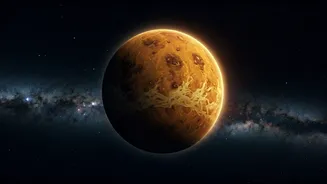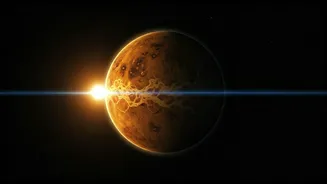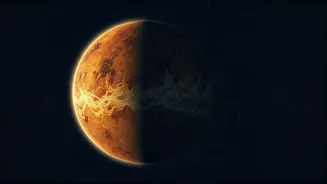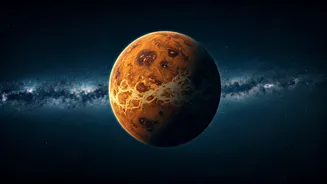


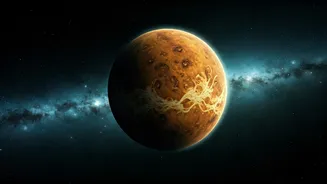
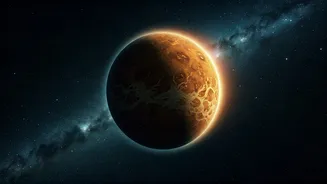
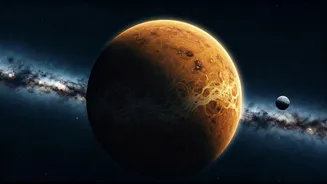


The Cosmic Time Warp
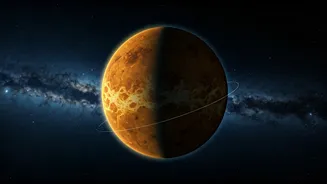
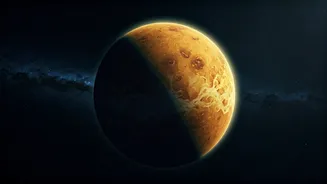
Let's get the mind-bending numbers out of the way first. It takes Venus about 225 Earth days to complete one full orbit around the Sun. This is its 'year'. However, it takes the planet a staggering 243 Earth days to spin just once on its axis. This is its 'sidereal
day'. Imagine our own planet taking longer to spin once than it does to circle the sun. By the time a Venusian 'day' is over, the planet has already completed an entire trip around the Sun and then some. This simple, stunning fact makes Venus unique among the planets we know and immediately separates it from Earth, where our 24-hour day is a tiny fraction of our 365-day year.
The Planet That Spins Backwards
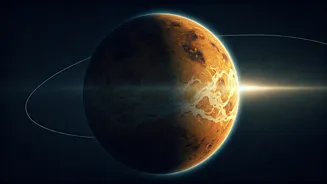
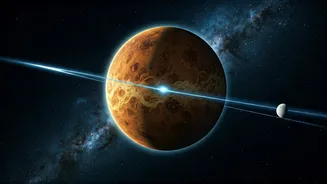
The key to understanding Venus's long day is its rotation. Not only is it incredibly slow, but it's also backwards. Most planets in our solar system, including Earth, spin on their axis in a counter-clockwise direction when viewed from above the North Pole. This is known as prograde rotation. Venus, however, spins clockwise, a phenomenon called retrograde rotation. This backward spin has profound consequences for how time passes on the planet. If you could stand on the surface of Venus, you would see the Sun rise in the west and set in the east, the complete opposite of what we experience on Earth. This strange directional spin is a crucial part of the puzzle.
The Solar Day 'Catch'
Here’s where it gets even stranger. While one full rotation (a sidereal day) takes 243 Earth days, the time from one sunrise to the next (a solar day) is different. Because the planet is spinning backwards as it moves forward in its orbit, the Sun appears to move across the sky faster than the planet's rotation alone would suggest. This results in a solar day on Venus that is 'only' about 117 Earth days long. So, while a single spin takes longer than a year, you would experience two sunrises in roughly one Venusian year. This means a Venusian 'day' (sunrise to sunrise) is shorter than its 'year', but its rotational period is longer. It's a celestial brain-teaser caused by the interplay of its orbit and its backward spin.
Why Is Venus So Weird?
Scientists don't have a single, definitive answer for why Venus is the odd one out, but there are compelling theories. One leading hypothesis is that in the chaotic early days of the solar system, a massive object—perhaps a planet-sized asteroid—slammed into Venus. Such a cataclysmic impact could have been powerful enough to not only slow its rotation to a crawl but actually reverse its direction. Another theory points to the planet’s incredibly thick atmosphere, which is 90 times denser than Earth’s. It's possible that over billions of years, strong atmospheric tides, combined with gravitational friction between the planet’s core and mantle, acted as a brake, gradually slowing and perhaps even reversing its original spin. The truth may be a combination of these factors, a mystery that future missions hope to solve.
Life in the Slow Lane
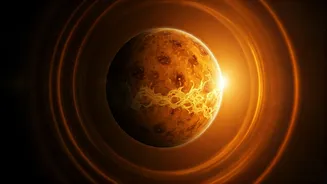
This bizarre rotation contributes to Venus's status as a hellscape. With a 'day' lasting nearly four Earth months, the sun-facing side bakes for an extended period. However, the planet's thick, carbon-dioxide-rich atmosphere is an incredibly efficient blanket. It traps heat so effectively that there is almost no temperature difference between the day and night sides, or between the equator and the poles. The entire planet is roasted at a constant, lead-melting 462 degrees Celsius. The slow rotation means Venus lacks a strong magnetic field like Earth's, leaving it exposed to solar winds that stripped away any water it may have once had. The long day isn't just a quirky fact; it's an integral part of what makes Venus the most inhospitable terrestrial planet in our solar system.