

The Challenge of the Red Dirt
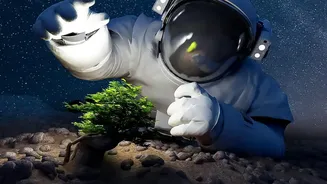
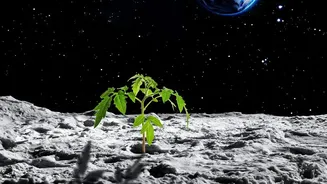
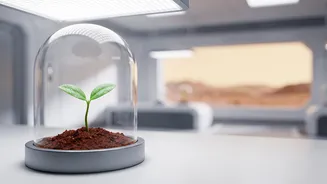
You can't simply plant a potato in the ground on Mars and hope for the best. The Martian environment is incredibly hostile to Earth-based life. The planet’s surface is covered in regolith, a dry, dusty material devoid of the organic matter and beneficial
microbes that make Earth’s soil fertile. This regolith is also laced with toxic chemicals called perchlorates, which are harmful to both plants and humans. On top of that, Mars has a whisper-thin atmosphere, receives about half the sunlight of Earth, and experiences bone-chilling average temperatures of around -60°C. Without a protective magnetic field, the surface is bombarded with cosmic radiation. Any attempt at Martian agriculture must first overcome these immense environmental hurdles.
Greenhouses: A Bubble of Earth
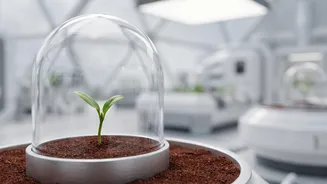
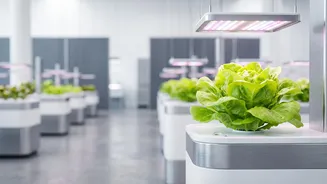
The most viable solution is to create controlled, self-contained environments. Future Martian farms will likely exist inside advanced greenhouses, designed to replicate Earth-like conditions. These structures would need to be pressurized, heated, and shielded from radiation. Inside, specialized LED lighting systems, pioneered through decades of research on the International Space Station (ISS), would provide the specific wavelengths of light plants need for photosynthesis. These bioregenerative life support systems would be marvels of efficiency, designed as closed loops where every resource is recycled. Water would be continuously purified and reused, and the carbon dioxide exhaled by astronauts would be fed to the plants, which in turn would produce vital oxygen.
From Toxic Regolith to Fertile Soil
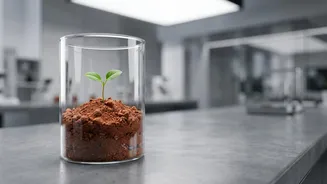
Even inside a greenhouse, the question of what to grow plants in remains. While soilless methods like hydroponics and aeroponics are leading contenders, using the readily available Martian regolith is a key goal for long-term sustainability. This requires treating the soil. Scientists are developing multi-step strategies to detoxify the regolith and enrich it. One promising approach involves using specific bacteria that can break down the toxic perchlorates. Once detoxified, the regolith needs nutrients. Researchers have shown that hardy plants like alfalfa can grow in the nutrient-poor regolith and then be used as a biofertilizer to enrich the soil for other food crops like lettuce, radishes, and turnips. This process kick-starts a living ecosystem, turning sterile dust into productive farmland.
Choosing the Right Crops
Not all plants are created equal when it comes to space farming. The ideal crops for Mars would be fast-growing, require minimal resources, and have a high harvest index—meaning most of the plant is edible. Early missions will likely focus on leafy greens like lettuce and mustard greens, radishes, and herbs, similar to what astronauts have already successfully grown and eaten on the ISS. For larger, more established settlements, staple crops like potatoes, wheat, and soybeans would be essential. To meet these challenges, scientists are also exploring synthetic biology and genetic engineering to develop new crop varieties specifically adapted for Martian conditions, with enhanced resistance to cold, drought, and radiation.
More Than Just Food
The benefits of growing plants on Mars extend far beyond the dinner plate. The process is a core part of a life support system, producing breathable air and recycling water. But just as importantly, plants provide profound psychological benefits. In the sterile, isolated, and high-stress environment of a Martian outpost, the simple act of gardening can be a powerful countermeasure against anxiety and depression. Studies with astronauts have shown that caring for plants provides a meaningful and engaging task, reduces stress, and offers a vital connection to nature and Earth. The sensory experience of seeing, touching, and smelling living plants—and eating fresh food—can be a huge morale booster for crews millions of miles from home.