




A Breakthrough in Alien Meteorology
For decades, the weather on planets outside our solar system was the stuff of science fiction and educated guesswork. We knew these worlds existed, but their climates were shrouded in mystery, light-years away. Now, that is changing. In a significant
leap forward for astronomy, scientists using the James Webb Space Telescope (JWST) have developed a new technique to detect and map cloud cycles on distant exoplanets. This breakthrough is transforming our ability to understand the atmospheres of these strange new worlds.
Peering Through the Haze of a Hot Jupiter
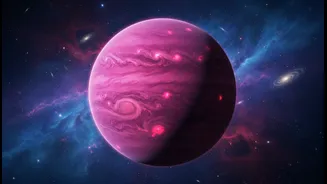
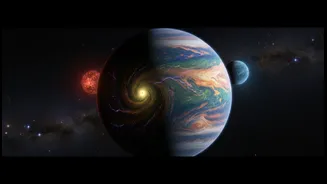
The new method was tested on a 'Hot Jupiter' named WASP-94A b, a gas giant located about 700 light-years away. These planets are tidally locked, meaning one side perpetually faces its star, creating a blistering hot 'dayside' and a cooler, permanently dark 'nightside'. Using the incredible sensitivity of the JWST, an international team of scientists observed the planet as it passed in front of its star. By analysing the light filtering through the planet's atmosphere at its leading edge (morning) and trailing edge (evening), they discovered a distinct weather pattern: the mornings are thick with clouds, while the evenings are surprisingly clear.
How to Forecast on Another World
So what causes this predictable daily forecast on WASP-94A b? Scientists believe that on the colder nightside, minerals in the atmosphere condense to form clouds, possibly made of substances like silicate — the same material that forms sand on Earth. Powerful winds, driven by the extreme temperature difference between the day and night sides, then whip these 'sand clouds' around to the morning side. As the clouds travel across the scorching dayside, the intense heat from the star vaporizes them, leading to clear skies by the time evening arrives. This represents the first clear discovery of a planet-wide cloud cycle in action on a distant world.
More Than Just a Weather Report
This new ability to distinguish between cloudy and clear regions has profound implications. Previously, astronomers had to assume a planet's atmosphere was uniform, which could lead to inaccurate measurements. The team studying WASP-94A b found that if they had ignored the weather patterns, they would have incorrectly calculated the amount of oxygen in its atmosphere by a factor of 100. By understanding the weather, we can get a much truer picture of a planet's chemical composition and, by extension, its history and formation. This method also helps refine climate models for our own planet.
The Search for Habitable Skies
While Hot Jupiters with their mineral clouds and extreme winds are far from habitable, these techniques are crucial stepping stones. Other recent studies have used similar methods to detect magnetic fields that could protect atmospheres, and even analyse the atmosphere of a planet orbiting a dead star. Each discovery provides another tool in the toolkit for exo-cartography, the science of mapping alien worlds. The ultimate goal is to apply these methods to smaller, rocky, Earth-like planets. By understanding how to read the weather on a world of lava or a gas giant, we are learning the language we will need to one day spot the tell-tale signs of a habitable climate on a distant, Earth-like cousin.