


In the vast expanse of space, planets don't just vanish. Yet, for years, astronomers were baffled by a world that seemed to disappear. Now, new data has solved the mystery, revealing a complex cosmic dance orchestrated by unseen forces.
The Case of the Phantom Planet
The story begins
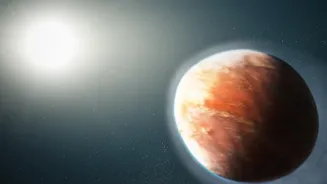
with a planet designated TOI-2535 b, located about 1,000 light-years from Earth. Classified as a 'hot Jupiter', this gas giant is similar in size to our own Jupiter but orbits its star at a blistering pace, completing a full circle in just over eight Earth days. For seven years, from 2019 to early 2026, astronomers using NASA's Transiting Exoplanet Survey Satellite (TESS) watched this distant world by tracking the slight dip in starlight each time it passed in front of its star. This 'transit' method is a reliable way to spot exoplanets. But TOI-2535 b was not behaving like a typical planet.
An Irregular Orbit
Scientists noticed that the planet's transits were not happening on a clockwork schedule. Instead, TOI-2535 b would often arrive up to six hours early or six hours late for its appointment to cross its star. Over the years, these transits also became progressively shorter and shallower. Then, in March 2026, the planet seemingly vanished. The characteristic dip in starlight that TESS had faithfully recorded for years was gone, leaving astronomers with a significant puzzle: how does a planet simply disappear from view?
The Unseen Neighbour
The answer, it turns out, is that the planet didn't vanish at all. The updated data from TESS's long-term observations allowed a team of researchers to piece together the celestial mechanics at play. Their conclusion, detailed in 'The Astrophysical Journal Letters', is that TOI-2535 b is not alone. The gravitational pull of an unseen, nearby planetary companion is tugging on its orbit. This constant pulling and pushing between the two worlds is causing their orbits to 'wobble'. The universe, it seems, is not always the perfectly regular clockwork we might imagine it to be.
A Change in Perspective
This orbital wobble is the key to the planet's disappearing act. The gravitational interactions tilted TOI-2535 b's orbit just enough that, from our viewpoint here on Earth, it no longer crosses the face of its star. The planet is still there, faithfully orbiting its sun, but its path has shifted out of our line of sight. This phenomenon, where the geometry of a transit changes over time, is a powerful reminder that our ability to detect exoplanets often depends on a precise and sometimes temporary alignment. What we see is not always the full picture.
Why This Discovery Matters
Solving the mystery of TOI - 2535 b is more than just finding a 'lost' planet. It provides crucial insights into how planetary systems evolve. The existence of hot Jupiters so close to their stars is already a puzzle, as they are thought to form much farther out before migrating inwards. The strong gravitational interactions seen in this system suggest that violent events and the influence of neighbouring planets play a significant role in shaping these unusual orbits. This 'disappearance' has ironically illuminated the hidden dynamics of the system, turning an observational loss into a scientific gain and offering clues about how such planetary arrangements develop over time.