





A Glimpse into Another World
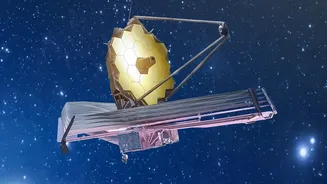
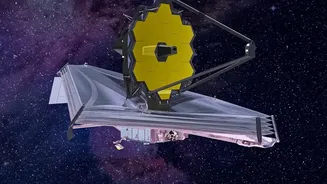
In a landmark discovery, astronomers using the JWST have found the best evidence to date for an atmosphere surrounding a rocky 'super-Earth' known as 55 Cancri e. Located 41 light-years away, this planet is a scorching-hot world, orbiting so close to its
star that its surface is likely a molten ocean of magma. While it’s far from habitable, the mere presence of a sustained gaseous envelope is a monumental finding. Previous observations hinted at an atmosphere, but it is Webb's powerful infrared capabilities that have allowed scientists to distinguish between a thin veil of vaporised rock and a more substantial, secondary atmosphere likely bubbling from the planet's interior.
What Exactly is a Super-Earth?
The term 'super-Earth' might conjure images of a bigger, better version of our own planet, but in astronomy, it's a simple classification based on size and mass. A super-Earth is an exoplanet—a planet outside our solar system—with a mass higher than Earth's but less than that of our ice giants, Neptune and Uranus. They can be rocky, gaseous, or a combination. Super-Earths are one of the most common types of planets found in our galaxy, yet, curiously, our own solar system doesn't have one, making them a fascinating subject of study. Finding them with atmospheres is a critical step in understanding which of these thousands of worlds might be capable of harbouring life.
How Webb Sees the Unseeable
So, how does a telescope 1.5 million kilometres away detect gases on a tiny planet light-years from Earth? The technique is called transmission spectroscopy. When an exoplanet passes, or 'transits', in front of its host star from our point of view, a tiny fraction of the starlight passes through the planet's atmosphere. Different gases in the atmosphere absorb specific wavelengths, or colours, of light. By capturing the starlight that has been filtered through the planet's atmosphere, JWST's highly sensitive spectrographs can identify the chemical fingerprints of molecules like water vapour, carbon dioxide, and methane. For 55 Cancri e, the data hinted at the presence of gases like carbon monoxide or carbon dioxide, which make up its secondary atmosphere.
More Steam Than Water
The headline mentions water vapour, which always raises excitement about habitability. While JWST has detected water vapour in the atmospheres of other planets, such as the mini-Neptune GJ 1214 b, it's crucial to manage expectations. On a world as hot as 55 Cancri e, where surface temperatures can reach 1,500 degrees Celsius, any water would exist as steam. On GJ 1214 b, the water vapour is part of a thick, hazy atmosphere, and the planet is also too hot for liquid water oceans. However, these discoveries are vital because they prove that planets, even those in extreme environments, can hold onto the chemical ingredients that are, on a world like ours, essential for life.
Not a Second Earth... Yet
Scientists are careful to point out that this is not confirmation of a habitable world. The atmosphere of 55 Cancri e is likely a blistering, toxic mix of gases bubbling from a magma ocean. In other cases, like the study of GJ 486 b, astronomers have had to consider whether the water signal was coming from the planet's cool starspots rather than the planet itself. These challenges are part of the scientific process. Each observation, even a puzzling one, refines our techniques and brings us closer to the ultimate goal: finding a rocky planet with a temperate climate and a life-sustaining atmosphere. This discovery on 55 Cancri e is a crucial proof of concept—it shows that a rocky planet can maintain a significant atmosphere even when blasted by intense stellar radiation.